“A good lead replied on Friday. We answered on Wednesday.”
Every reply is found and answered in draft the day it arrives. Nobody has to remember.
One system for the whole business.
Most clients start with growth. Then the same system takes on the work behind it.
All servicesHow the system works ExampleSee an Operations Map for a firm like yoursFifteen sectors, from law firms to construction.
 Website That Sellsarum: 310 pages rebuilt across three regionsIn weeks.
 Business Operating SystemFive people. The work of 30.We run our own firm on it first.
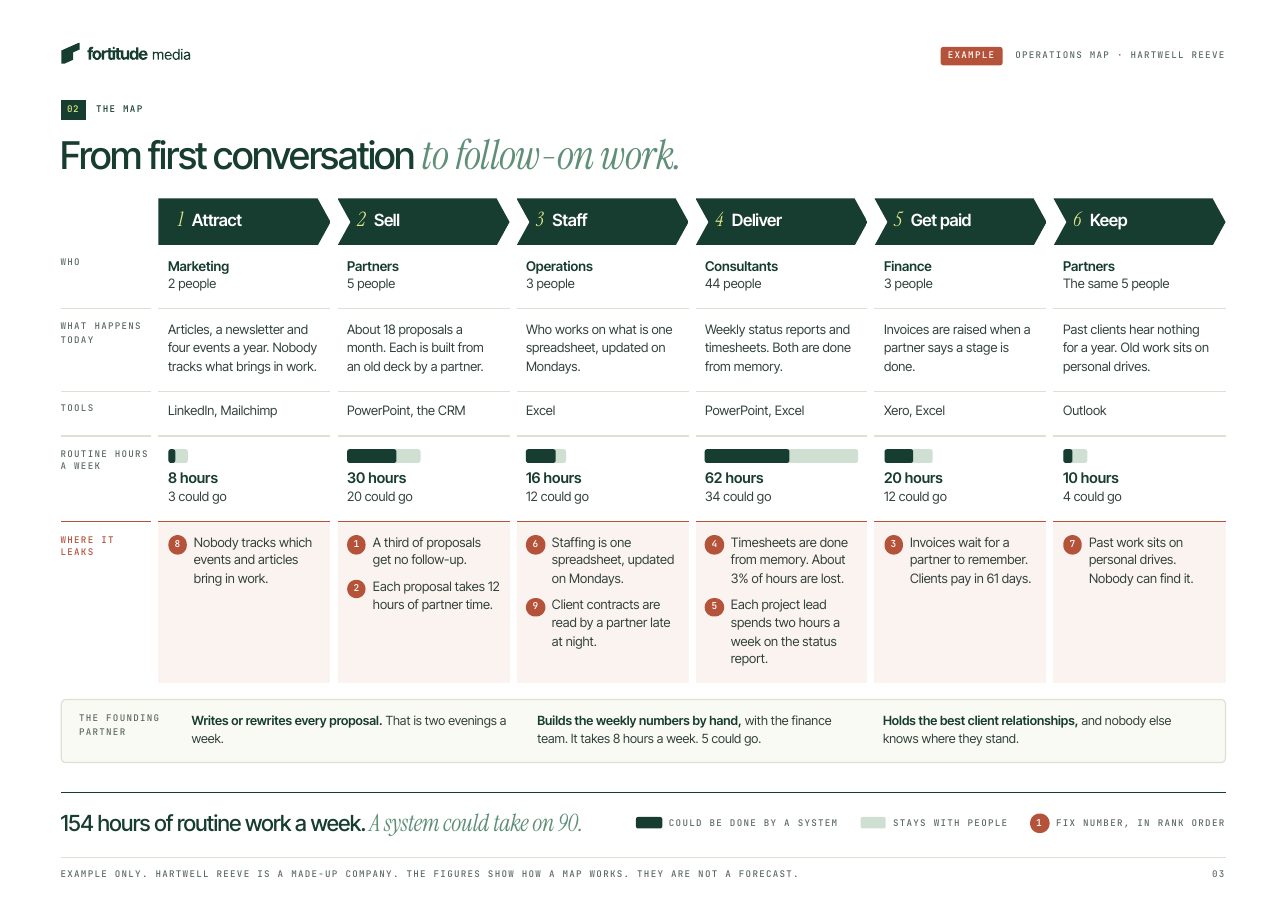 Operations MapWhere the hours go, team by teamYours to keep, whatever you decide next.
 The conversation30 minutes with DavidNo charge. You leave with it in writing.

“We doubled revenue. We nearly doubled the team too.”




“We built a $50m business with 200 people. Today it would take 20.”
Talk to a founder. 30 minutes. No charge.
Book a conversationWin clients · Be chosen · Sales Team That Closes
Fortitude Foundry does the lists, the research, the first emails, the chasing and the typing up that eat a salesperson’s week. Your people spend the day with buyers, and no lead waits for an answer.
This is what a salesperson opens at 8.30. The work was done overnight. They read, change what they like and approve, in about ten minutes.
Each morning Foundry tells every seller the three things worth doing first, with the numbers behind them.
Every first email is written from real research, then checked. Nothing reaches a buyer until one of your people approves it.
Foundry spots the reply, drafts the answer with your booking link, and opens the deal when it is a yes.
Every prospect gets a scorecard of their own website: what works, what does not, and three fixes they can keep.
People, emails, LinkedIn notes, meetings and research on a single page. Email and LinkedIn worked together.
Coach reads which opening lines win replies in each sector and suggests better ones. You accept or dismiss.
Live cues while you talk: the objection, the buying signal, the promise you just made. The follow-up is written when you hang up.
Client requests from email and Slack are sorted, checked against the brief and answered in draft.
From first email to won deal, by person and by week. No spreadsheet, no chasing for numbers.
The week goes on lists, research, chasing and typing things up. None of it needs a salesperson, and all of it slows the deals you already have.
“A good lead replied on Friday. We answered on Wednesday.”
Every reply is found and answered in draft the day it arrives. Nobody has to remember.
“Our best closer spends Monday building lists.”
The list is built and researched overnight. Monday is for meetings.
“We pay for a CRM. Nobody fills it in.”
Foundry writes the activity back. Your people never type it up.
Five jobs your salespeople put off, done before they sit down.
Companies like your best clients, found and scored. Nobody builds a list.
Every company read properly. No research, no email.
About their firm, not yours. It could not be sent to anyone else.
Follow-ups and replies written and waiting, with email and LinkedIn worked together.
A one-page brief before you walk in. The next step written down and chased after it.
The part a buyer remembers, and the part your salespeople are good at.
Autopilot, with a pilot. Nothing reaches a buyer until one of your people has approved it.
Speed and momentum win deals. The firm that answers first, follows up on time and turns up prepared gives a buyer the fewest reasons to look elsewhere.
of selling time back every year.
Four sellers, at the 4.8 hours a week Gartner found AI saves a seller.replies to every lead, not 42 hours later.
42 hours is the average first response in a Harvard Business Review audit of 2,241 firms.a morning is all it asks of each salesperson.
To read, change and approve what was written overnight. The rest of the day is theirs.For a team of 3 to 10 sellers, Foundry costs £39,500 a year less than an in-house SDR once it is built. Four new clients a year pays for it, at £15,000 a client and a 50% margin.
Swipe sideways for all four
| Hire an SDR | Retain an agency | Buy an AI tool | Foundry | |
|---|---|---|---|---|
| Cost, first year | About £69,500 | £36,000 to £96,000 | $250 to $3,750 a month, plus someone to run it | £44,999. Or from £999 a month, per meeting. |
| Cost, every year after | About £69,500 | £36,000 to £96,000 | The same | £30,000 |
| Who sets it up and tunes it | Your sales manager | The agency | You do | We do |
| Working properly in | About three months | Two to four weeks | Days to switch on. The tuning never ends. | Four to six weeks |
| You are tied in for | Notice, then rehiring. SDRs stay 1.9 years on average. | 6 or 12 months | A month to a year | 30 days |
| Who decides what is sent | Your SDR | The agency | The tool, unless someone checks | Your own salespeople |
| Makes phone calls | Yes | Usually | Some do | No. Your people do. |
| If you stop, you keep | What made it into the CRM | Check before you sign | Whatever you export | All of it: lists, playbook, threads |
Foundry figures are for a team of 3 to 10 sellers. SDR and agency costs: Fortitude Media guide, citing ORRJO and Air Marketing, 2026. Ramp and tenure: The Bridge Group, 2025. AI tool prices are the published tiers of AiSDR and 11x, as reported in 2026.
Someone still has to choose the targets, feed it, check what it writes and fix what it gets wrong. That is the job you were trying to get rid of. With Foundry that work is ours.
Same data, same prompts, same emails. Your buyers now spot them in a line. Foundry writes from research on each firm, in your voice.
One bad batch reaches people you have spent years getting to know. In Foundry nothing goes until one of your people has approved it.
If the left-hand list is you, buy the tool. It will cost less than we do. Most firms find they have neither the person nor the time, which may be why one industry estimate puts yearly cancellations of AI SDR tools at 50 to 70%. Source: UserGems, cited by Autobound.
Foundry is not a CRM and does not ask you to replace yours. We build it around the one you have, whether that is HubSpot, Salesforce, Pipedrive or something else, and it keeps the records up to date without anyone typing.
Your CRM keeps the records. Foundry does the work. Most firms find they need fewer seats and fewer tools each year. That is your decision, at your renewal, when you are ready.
If you lean on your CRM for marketing automation, service tickets or quoting, keep it for those. We will say so.
Foundry reads your companies, contacts and deals, and writes activity back. Your people work in Foundry.
Sellers stop opening the CRM. Managers read the pipeline in Foundry. The tools around the CRM start to go.
A cheaper tier, fewer seats, or none. Your data is already in your own accounts.
Rented software gives every seller the same screen. Foundry is fitted to how your firm sells and how each of your people likes to work.
Per-seat tools charge you more for every person you hire. Foundry is built once, and its cost does not rise with your headcount.
What Foundry will not do. It will not send anything a person has not approved. It will not make your calls or sit in your meetings. And it will not rescue an offer nobody wants. We would rather tell you that now.
Pay for meetings as they happen, or own the whole thing. Most firms start with the first and move to the second. All prices exclude VAT.
Built around your CRM and your people, priced by the size of your team and never per seat. Stop after any step. Once you own it, the per-meeting fees stop.
25 prospects like your best client, researched, with the first three emails written. David goes through them with you.
Yours to keepHow your team sells today, measured, with the plan and the sums.
Yours to keepBuilt around your CRM, your email and each seller. You own it outright.
Priced by team size, never per seatMonitoring, weekly improvements, new lists and new opening lines.
No minimum term. 30 days' notice| People who sell | Build, once | Run, a month | First year, all in | Each year after | Owning costs less from |
|---|---|---|---|---|---|
| 1 or 2 | £6,000 | £1,500 | £26,999 | £18,000 | 4 a month |
| 3 to 10 | £12,000 | £2,500 | £44,999 | £30,000 | 6 a month |
| 11 to 30 | from £18,000 | from £4,000 | from £68,999 | from £48,000 | 9 a month |
First year, all in, is the sales audit, the build and twelve months of running. The last column is the number of held meetings a month at which owning costs less than paying per meeting. Your own data and AI accounts are paid directly, and priced in the sales audit.
We run Fortitude with five people doing the work of 30, and Foundry is how we find and win our own clients. We built it because we could not buy it.
Our founders built and ran their own companies first, including one that reached $50m a year with 200 people. David Adams builds the automation and takes every first call himself.
It is fitted to each of them: what their morning message says, which columns they see, how their emails sound. It also asks for ten minutes, not a new habit. They open it because the replies and the meetings are in it.
No. Foundry is built around the one you have and keeps it up to date. Whether you need fewer seats later is your call.
No. AI researches and drafts. Your people read, change and approve. No research, no email, and nothing reaches a buyer without a person saying yes.
One that took place, with a firm that fits the criteria we agreed and a person who owns or shapes the decision, who knew what the meeting was about. A no-show does not count, and is rebooked once, free.
If you have someone to run it and tune it, do. It will cost less. Foundry is for firms who want the work done: we set it up, write from research on each prospect, and your people approve everything before it goes.
It is the same system. On Pipeline That Fills our people write, approve and handle the replies. Here your own salespeople do, in ten minutes a morning, which is why each meeting costs less and why you can own it outright.
In the UK you can email people at companies without prior consent, as long as you say who you are and offer a way out. Sole traders and some partnerships are treated as individuals. Foundry keeps your opt-out list. You are the sender, so take your own advice.
Yes. The sales audit is yours to keep, with the plan in it. Some firms take it and build. Most would rather have it in six weeks.
Give us your website and the name of your best client. We will find 25 companies like them, research each one and write the first three emails.
You see it all in 30 minutes with David, and keep it either way. If you like what you see, the next step is a 90-day pilot at £999 a month. No deck, no card, no contract.
Cold email still works when it is researched and low volume. What the Google, Yahoo and Microsoft sender rules require, and how to set up sending properly.
A UK SDR earns about £33,000 base but costs over £63,000 in year one. How that compares with outsourced outbound, and when each makes sense.
Why referrals dry up for growing B2B firms, why they still matter, and the three routes beyond them: being found, being trusted and researched outbound.
10% of everything we invoice goes to founders in crisis, through the Fortitude Foundation. It costs you nothing extra.
How the 10% works
Thirty minutes with David. No charge and nothing to sign.

“I’m blown away by Fortitude.”
No time that suits? David has your details and will reply within one working day.
He will have looked at your firm before the call. The invitation is on its way to your inbox from Calendly, with the video link.