







Running the firm on systems.
How a founder-led firm grows without adding people at the same rate: where the time goes, which work to hand to AI first, what it costs against hiring, and what stays with people.
You doubled revenue and nearly doubled the team. Your best people spend half the week on admin. The numbers arrive a month after they matter, and the board keeps asking what the AI plan is. These guides are for the founder in that position.
They start with the basics: what a business operating system is, and how to grow revenue without growing headcount at the same rate. Then the method: how to find out where your team's time really goes, which jobs to automate first, and what automating a department costs compared with hiring.
Two guides deal with the questions that stop most firms: why AI pilots stall and what should stay with people. If your board is asking, what an AI plan for the board should say gives you one page to work from.
There is a guide for each sector we know well, starting with professional services and recruitment, with more added every Tuesday and Thursday.
We run our own firm this way: five of us do the work that took 30 at our previous companies. How we run Fortitude shows it, and the Business Operating System page sets out how we do the same for clients.
Last reviewed 18 November 2026.
How do law, accounting and advisory firms cut admin without cutting care?
Fee earners lose hours a day to intake, letters, checks, billing and updates. What a system can take on, what the SRA, ICAEW and FCA say, and what stays with a qualified person.
Read the guideAll 10 guides in this topic
How do recruitment agencies place more people without adding consultants and admin?
Your consultants spend the day chasing timesheets, diaries and paperwork. Which recruitment jobs a system can run on its own, the UK rules that apply, and what stays with the consultant.
How do we find out where our team's time really goes?
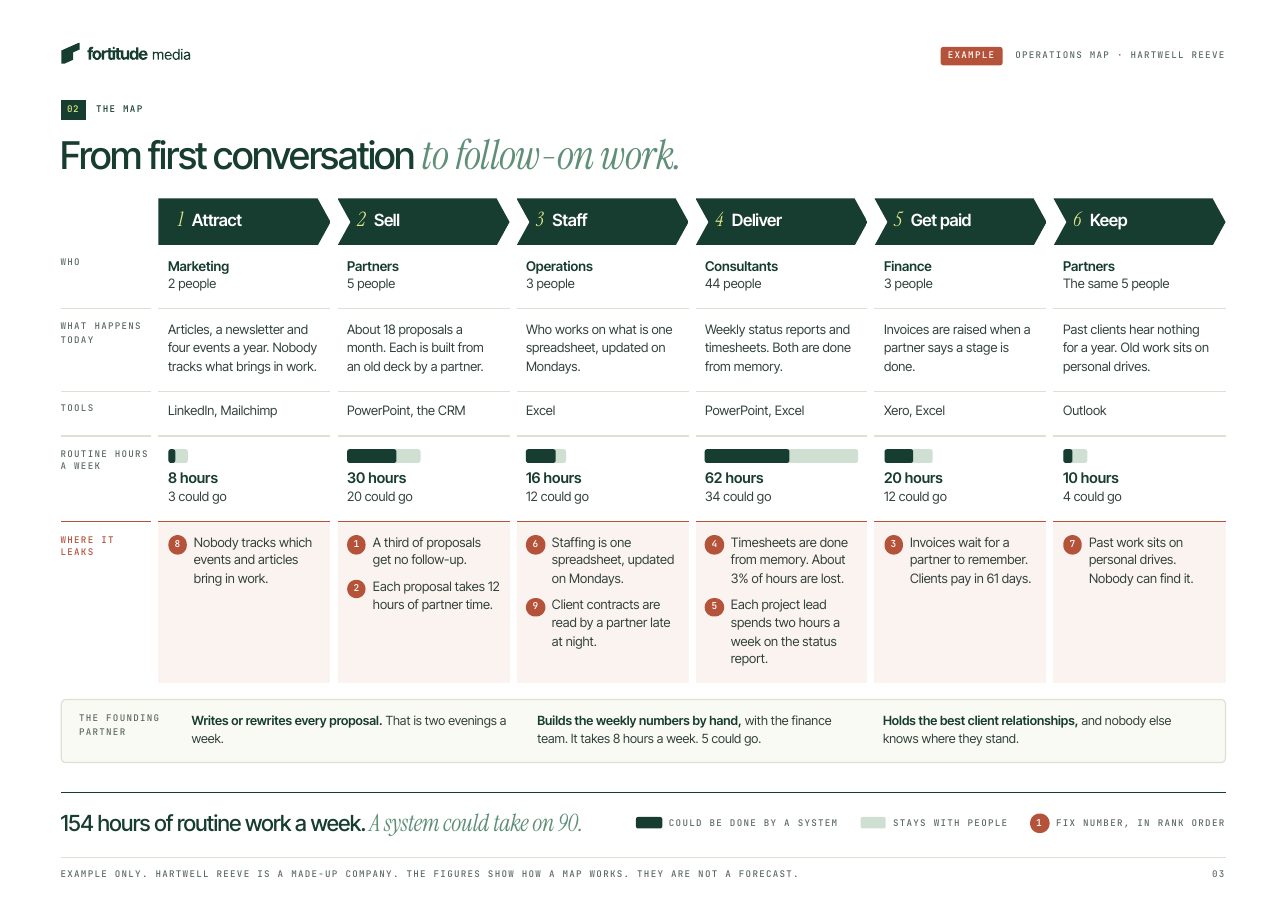
Everyone is busy and nobody can say where the week goes. How to map routine work team by team, turn it into hours and pounds, and see what a system could take on.
How do we grow revenue without growing headcount at the same rate?
You doubled revenue and nearly doubled the team. How to measure revenue per employee, why headcount tracks revenue in service firms, and what to change first.
The board keeps asking about our AI plan. What should it say?
The board wants to know what your AI plan is, and a few ChatGPT logins is not an answer. A one-page structure, the UK rules directors should know, and what not to promise.
We tried an AI pilot and it never left the pilot. Why, and what works instead?
The demonstration went well, then nothing. Why most AI pilots stall, what the research says about success rates, and how to take one area of the business to live use.
What does automating a department cost compared with hiring?
Another hire, or a system for the routine work? The full cost of a UK employee in 2026 to 2027 against the set-up and running costs of automation, with payback sums.
What is a business operating system, and does a firm our size need one?
The board wants an AI plan and you have a few licences and a stalled pilot. What a business operating system is, how it differs from software or hiring, and when it is too early.
What should stay with people when AI does the routine work?
When AI takes the routine work, clients ask who checked it and staff ask what happens to their jobs. What stays with people, how approval steps work, and what the evidence says.
Which jobs should we automate first, and which should we leave alone?
Forty ideas for using AI and budget for three. A way to rank work by volume, rules and risk, what to leave with people, and examples by department.
Common questions.
What is a business operating system?
It is the set of systems that does the routine work in your marketing, sales, finance and client service, with your people approving what matters. It is not one piece of software. It is your existing tools joined up, with AI doing the repeatable steps between them and a person checking what goes out.
Where should we start?
With a count, not a tool. Sit with each team, write down the jobs that repeat, and put hours against them. The first area to automate is usually the one with the most volume and the least risk, such as follow-up, invoicing or client updates.
What stays with people?
Judgment, relationships and anything unusual. A system can draft the proposal, raise the invoice and send the update. A person decides the price, handles the difficult conversation and approves what goes out under the firm's name.
How do we know it is working?
Measure sales per person and the hours returned to each team, not the number of tools in use. Agree the measure before the first area is built, and review it every month.
Ready to find out where you stand?