









On this page · 9 sections
You run a recruitment agency with a floor of good consultants, and they all tell you the same thing: the day goes on everything except recruiting. Chasing a timesheet. Rebooking an interview for the third time. Finding the passport scan that should have been on file a week ago.
The market has not made it easier. The Recruitment and Employment Confederation (REC) estimates the industry made 536,400 permanent placements in 2024, a third fewer than the year before, while the number of recruitment businesses rose to 31,345 in 2025. More firms are chasing fewer roles. The old answer to growth, another consultant with another administrator behind them, now costs more than it returns.
This guide sets out where a consultant's week goes, which jobs a system can run on its own, the UK rules that decide how far you can go, and what has to stay with the consultant. It is about the work behind the desk. Winning clients is a separate job, covered on our recruitment page.
Where does a consultant's week actually go?
Mostly on finding and sifting candidates, then on the admin that sits around every placement. In Bullhorn's 2026 survey of nearly 300 recruitment professionals in the UK and Ireland, recruiters said searching for candidates takes the most time in their day, followed by screening applicants.
The admin is harder to see. Totaljobs asked 748 UK HR leaders in summer 2025 how long the manual tasks in hiring take. The answer was 17.7 hours a vacancy, including 3.6 hours reviewing applications, 3.1 hours on data entry and 2.5 hours scheduling interviews. Those are in-house recruiters, so treat the figure as a guide. An agency desk has the same jobs, plus several an employer never sees.
| Job on the desk | What it involves | Needs a consultant? |
|---|---|---|
| Taking the brief | Understanding the role, the team and the hiring manager | Yes |
| Search and screening admin | Reading applications against the brief, chasing missing details, updating records | Partly: the judgement, not the sorting |
| Interview scheduling | Matching diaries, confirming, reminding, rebooking | No |
| Registration and compliance | Identity, right to work, qualifications, references, terms | A person checks; a system chases and files |
| Timesheets and invoicing | Collecting approved hours, matching rates, raising and chasing invoices | No, with approval before money moves |
| Client updates | Where each role stands this week | A consultant reads and sends |
| Offer and close | Negotiating, handling counter-offers, keeping the candidate warm | Yes |
Nobody sees the total, because it is a few hours of everyone's week and not one person's job. Before you change anything, add it up. Our guide to finding where your team's time goes shows how.
Which jobs can run on their own?
The ones with clear rules, a clear trigger and a result someone can check. On a recruitment desk that means five jobs.
Candidate screening admin
A system can read each application against the must-haves in the brief, ask the candidate for what is missing, update the record and draft the acknowledgement. The consultant still decides who goes forward. In the Bullhorn survey most recruiters said AI is reducing the time they spend searching and screening by 26 to 75%, and 60% of agencies already have some automation in search.
Interview scheduling
Offering slots from two diaries, confirming, reminding and rebooking is pure coordination. It is 2.5 hours a vacancy in the Totaljobs figures, and none of it needs a consultant's judgement.
Compliance and right to work paperwork
A system can request each document, check the pack is complete, record the dates, fill the Key Information Document from your template and warn you before a time-limited visa needs a follow-up check. The check itself has to follow the Home Office's prescribed steps, covered below.
Timesheets and invoicing
Reminding the worker and the hirer, matching approved hours to the agreed rate, raising the invoice and chasing it on a schedule are all rule-bound. They are also where growth gets stuck: 42% of recruiters told the REC that cashflow pressure had held back their business in the past 12 months. Bullhorn found the share of agencies with automation in payroll and billing is lower than the 60% that have it in search.
Client updates
A weekly note on each open role (CVs sent, interviews booked, feedback outstanding) can be drafted straight from your records. The consultant reads it, adds what they know and sends it.
In each case the system does the sorting, chasing and filing, and a person approves what goes out.
Which UK rules decide how far we can go?
Four sets of rules matter: the Conduct Regulations, right to work checks, data protection and HMRC reporting. None of them stops you automating. All of them leave the liability with the agency.
The Conduct Regulations
Since 7 April 2026 these have been enforced by the Fair Work Agency, which took in the Employment Agency Standards Inspectorate. The REC said at launch that nothing changed on day one, but that enforcement is expected to become more coordinated and more visible over time.
The agency's overview of the regulations lists what you must do. You need enough information from the hirer to select a suitable person before you introduce anyone. You must confirm the work-seeker's identity and that they have the experience, training and qualifications the role needs. Temporary workers must get a Key Information Document before terms are agreed. You cannot withhold a temp's pay because the hirer has not paid you. And records must be kept for at least 12 months. A system is good at exactly this: making each step happen in order and keeping the proof.
Right to work checks
An employer that has not done the correct checks can be fined up to £60,000 for each illegal worker. The Home Office's employer's guide of 1 October 2026 sets out three routes: a manual check of original documents, a Home Office online check using the person's share code, or a check through a registered digital verification service provider. Every step has to be finished before the work starts, and copies kept for the length of the employment and two years after.
Two points matter for agencies. First, the guide says the employer remains liable if a check is not carried out as prescribed, whoever or whatever helped. Second, from 1 October 2026 the scheme also covers workers' contracts, individual sub-contractors and online matching services, and the guide's own example treats an employment business supplying temps on contracts for services as the employer. So automate the chasing, the diary and the filing, and have a trained person or a registered provider do the check.
Data protection
When the Information Commissioner's Office audited AI recruitment tools in 2024 it made almost 300 recommendations. It found tools that let recruiters filter out candidates with certain protected characteristics, tools that guessed gender and ethnicity from a name, and tools that collected far more personal information than they needed and kept it indefinitely. Ask any supplier how their product avoids all three.
The ICO's draft guidance on automated decisions, updated in March 2026 for the Data (Use and Access) Act 2025, sets the safeguards where a significant decision is made by software alone. You must tell the person, let them put their side, give them a human review and a way to contest it. The reviewer needs the authority to change the decision, and spot checks do not count. We would treat rejecting a candidate as significant, so a person makes that call. The same law covers your outreach to hiring managers, which we cover in whether cold emailing other businesses is legal in the UK.
HMRC reporting
If you supply workers and do not operate PAYE on their pay, HMRC requires a report at least once every three months. A late report brings an automatic penalty of £250, rising to £500 and then £1,000 for repeat lateness within 12 months, and you must keep your evidence for at least three years. A system can assemble the report from placement and payment records. A person checks and sends it.
What has to stay with the consultant?
Judgement, relationships and accountability. That means taking the brief, the conversation that tells you whether a candidate is right, the shortlist, every rejection, the offer and the fee.
The close is the clearest example. Bullhorn found that two to three in every five candidates who receive an offer still turn it down, usually for a better one elsewhere. No reminder email fixes that. A consultant with time to ring the candidate sometimes can.
Our own rule is simple. Anything that reaches a customer or moves money is approved by a person, and every action is logged so you can see what the system did and why. On a recruitment desk, "customer" means candidates as well as clients. We go through the wider question in what stays with people when AI does the routine work.
It matters commercially too. Hiring managers look up the consultant after a call, and want signs that this person knows the market. Hours taken out of admin should go into exactly that. Our guide to why ChatGPT recommends other recruitment agencies covers the reputation side.
How do we start without breaking a desk?
Start small: one desk, one job, measured before and after.
Step 1: Count the hours on one desk
For two weeks, have one team note how long each job in the table above takes. You want hours a week, per job, across the team.
Step 2: Pick one job with clear rules
Choose the job with the most hours and the fewest judgement calls. On a temp desk that is often timesheets and invoicing. On a permanent desk it is often scheduling or screening admin.
Step 3: Write down how the job is done today
Record every step, every exception and who decides what. If two consultants do it differently, agree one way first. A system can only repeat a method that exists.
Step 4: Build it on the systems you already have
Use your existing recruitment CRM, timesheet tool and accounts package where you can, so the data stays in your accounts and nothing has to be re-keyed.
Step 5: Keep a person on approvals and log everything
Decide which outputs need a yes from a person before they go: anything a candidate or client receives, and anything that bills or pays. Keep a log of every action. It doubles as your compliance record.
Step 6: Measure for a month, then widen
Compare the hours with Step 1 and check the error rate. If both are better, move to the next job or the next desk.
What does it cost, and when should we not automate?
A build costs far less than a hire, but only where there is enough routine work to take on. Our prices are published on what it costs.
| Step | What you get | Price |
|---|---|---|
| Operations Map, one team | The routine hours counted, and a plan. About three weeks | £2,999 |
| Operations Map, whole business | The same across every team | £7,500 to £15,000 |
| Build, per area | Built, tested, live and your team trained. Four to eight weeks | From £6,000 |
| Run | Watched, fixed and improved every month, with no minimum term | £2,500 to £5,000 a month |
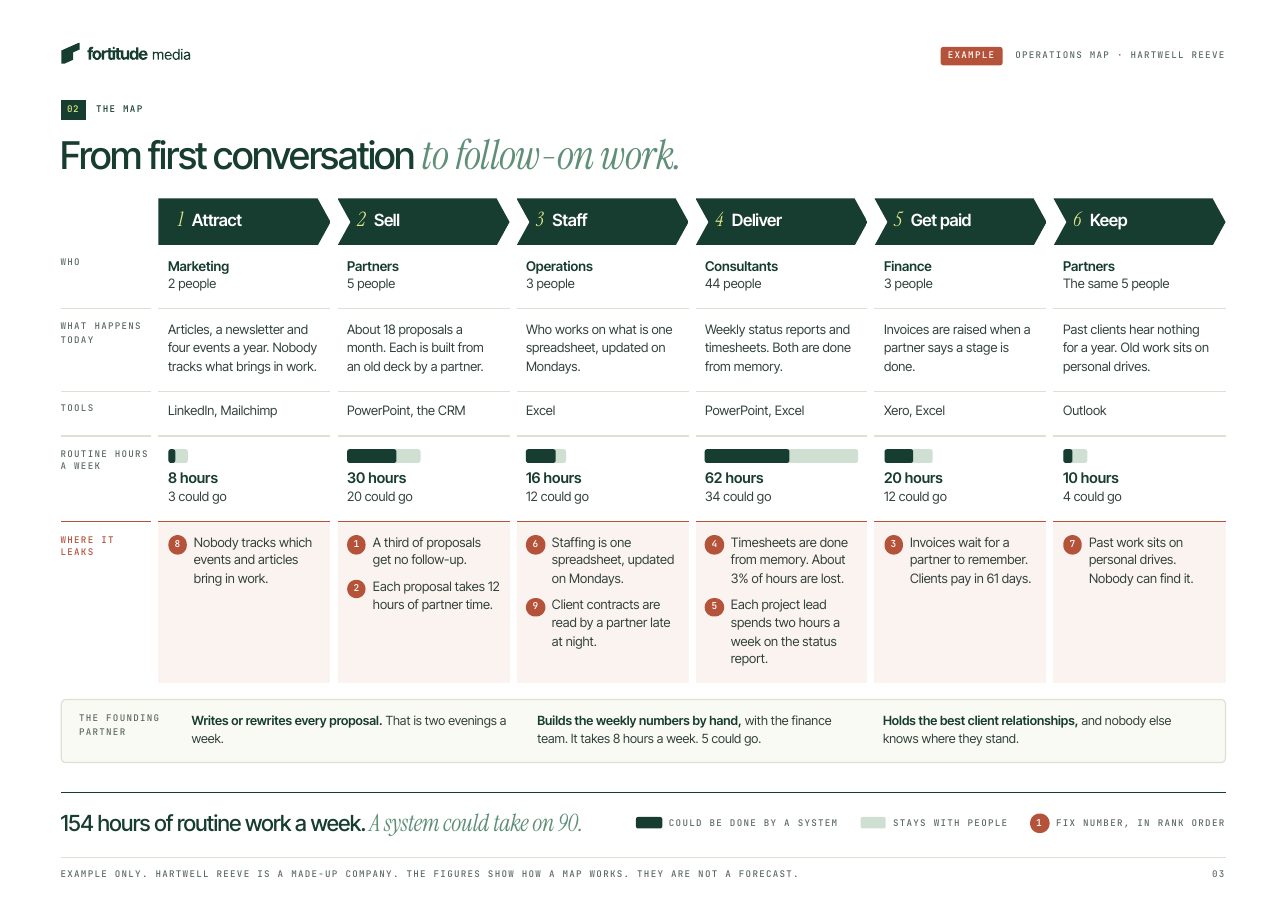
For scale, our example map for a made-up law firm prices 130 hours of routine work a week at £187,000 a year if covered by 3.5 more people, against £54,000 a year to run a system after builds of £26,000. It is an illustration, not a forecast, and not a recruitment agency. Your own count comes first.
There are times to leave a job alone. A retained search desk making a dozen placements a year may have too little volume to repay a build. A process that changes every month is not ready. And poor data gets in the way: in the Bullhorn survey, data quality and security were common obstacles and 28% of respondents said they lacked a clear implementation plan. Only 7% of agencies had AI embedded throughout their workflow.
We built our own firm this way first, one area at a time, and how we run Fortitude lists what the system does and what a founder still approves. The joined-up version, with one record, a written playbook and one weekly page, is what we call a Business Operating System.
What to do this month
- Ask one desk to log its hours by job for two weeks, using the table in this guide.
- List every step in your registration and compliance process, and mark which are checks a person must make and which are chasing and filing.
- Read the Fair Work Agency's overview of the Conduct Regulations and the October 2026 right to work guide against that list.
- Ask each software supplier you use how it handles protected characteristics, data retention and automated rejections.
- Count the days between a timesheet being approved and the invoice going out, and between invoice and payment.
- Pick the one job with the most hours and the clearest rules, and write down how it is done today.
To see where the routine hours sit in your agency, book a conversation: 30 minutes with a founder, at no charge.
Frequently asked questions
Can we use AI to reject candidates automatically?
We would not. Where software alone makes a significant decision about a person, the ICO's draft guidance says they must be told, allowed to put their side, and given a human review by someone with the authority to change the outcome. It is simpler and fairer to let the system sort and summarise, and have a consultant make and send every rejection.
Do we still need a compliance administrator?
You need a named person who owns compliance, though they may spend far less time chasing paper. The employer stays liable for right to work checks done wrongly, and the Conduct Regulations expect records you can hand to an inspector. A system does the requesting, dating and filing. A person carries out or signs off the checks.
Our recruitment CRM already has automation. Is that not enough?
It may be, for the jobs inside the CRM. Much of the admin sits between systems: the CRM, the diary, the timesheet tool and the accounts package. Bullhorn found 60% of agencies have automation in search but fewer in payroll and billing, and only 7% have AI embedded across their workflow. Check what your current tools can do before buying anything new.
Does the Fair Work Agency change what we have to do?
Not yet in substance. The Conduct Regulations are the same, and the REC said there was no sudden change to compliance obligations on day one. What changes is who enforces them, with enforcement expected to become more coordinated over time. Good records, kept automatically, are the sensible response.
How long before a first job is live?
With us, the first area is live seven to eleven weeks after we start: about three weeks for the map and plan, then four to eight weeks to build. Doing it yourselves can be quicker for a single simple job, such as interview scheduling, if someone has the time to own it.
Sources
- Recruitment and Employment Confederation, Recruitment sector contributes more than £40 billion a year to the UK economy despite tough job market (December 2025)
- Bullhorn, GRID 2026 Industry Trends Report, UK and Ireland (February 2026)
- Totaljobs, What's slowing down your hiring? (August 2025)
- Recruitment and Employment Confederation, Fair Work Agency launches (March 2026)
- Fair Work Agency, Overview of the Conduct Regulations 2003 (updated October 2026)
- GOV.UK, Penalties for employing illegal workers (checked November 2026)
- Home Office, Employer's guide to right to work checks (October 2026)
- Information Commissioner's Office, ICO intervention into AI recruitment tools leads to better data protection for job seekers (November 2024)
- Information Commissioner's Office, What are the ADM safeguards? Draft guidance (updated March 2026)
- HM Revenue and Customs, Employment intermediaries: what this means for an intermediary (updated July 2026)