










On this page · 9 sections
- Where do the non-billable hours go?
- What can run on its own?
- What do the regulators say about confidentiality and conduct?
- What must stay with a qualified person?
- How do we start without putting clients at risk?
- What does it cost, and when is it not worth it?
- What to do this month
- Questions founders ask
- Sources
Picture a partner who bills six hours and works ten. The other four go on opening files, chasing documents for identity checks, sending engagement letters, tidying time entries before the bills go out, and writing emails that begin "just a quick update". None of it is why the client chose you, and all of it has to be right.
The numbers are large. A LEAP survey reported in March 2026 found that UK legal professionals spend nearly three hours a day on non-billable tasks, the equivalent of 88 full working days a year. Sage's research, published in June 2026, found that accountants spend just 44% of their working week on core accounting and compliance work.
The worry is care. Clients pay for judgement and attention, and your regulator holds a named professional responsible for the result. This guide covers where the hours go, which jobs a system can take on, what the Solicitors Regulation Authority (SRA), ICAEW and the Financial Conduct Authority (FCA) have said, and what must stay with a qualified person.
Where do the non-billable hours go?
Into the work around the work: taking clients on, keeping them informed, recording time, billing and getting paid. It is spread across fee earners, secretaries and support teams, so nobody sees the total.
| Source | What it found | Based on |
|---|---|---|
| LEAP, Profitability in Law 2026 | UK legal professionals spend nearly three hours a day on non-billable tasks; 40% of respondents said excessive manual administrative work stopped their firm working efficiently | A survey of legal professionals in six countries including the UK |
| Sage, The Hidden Hours of Accountancy | Accountants spend 44% of the week on core accounting and compliance, down from 50% a year earlier; 62% say they spend too much time managing the practice; 81% regularly take on tasks outside the agreed scope | Sage's research among accountants, reported June 2026 |
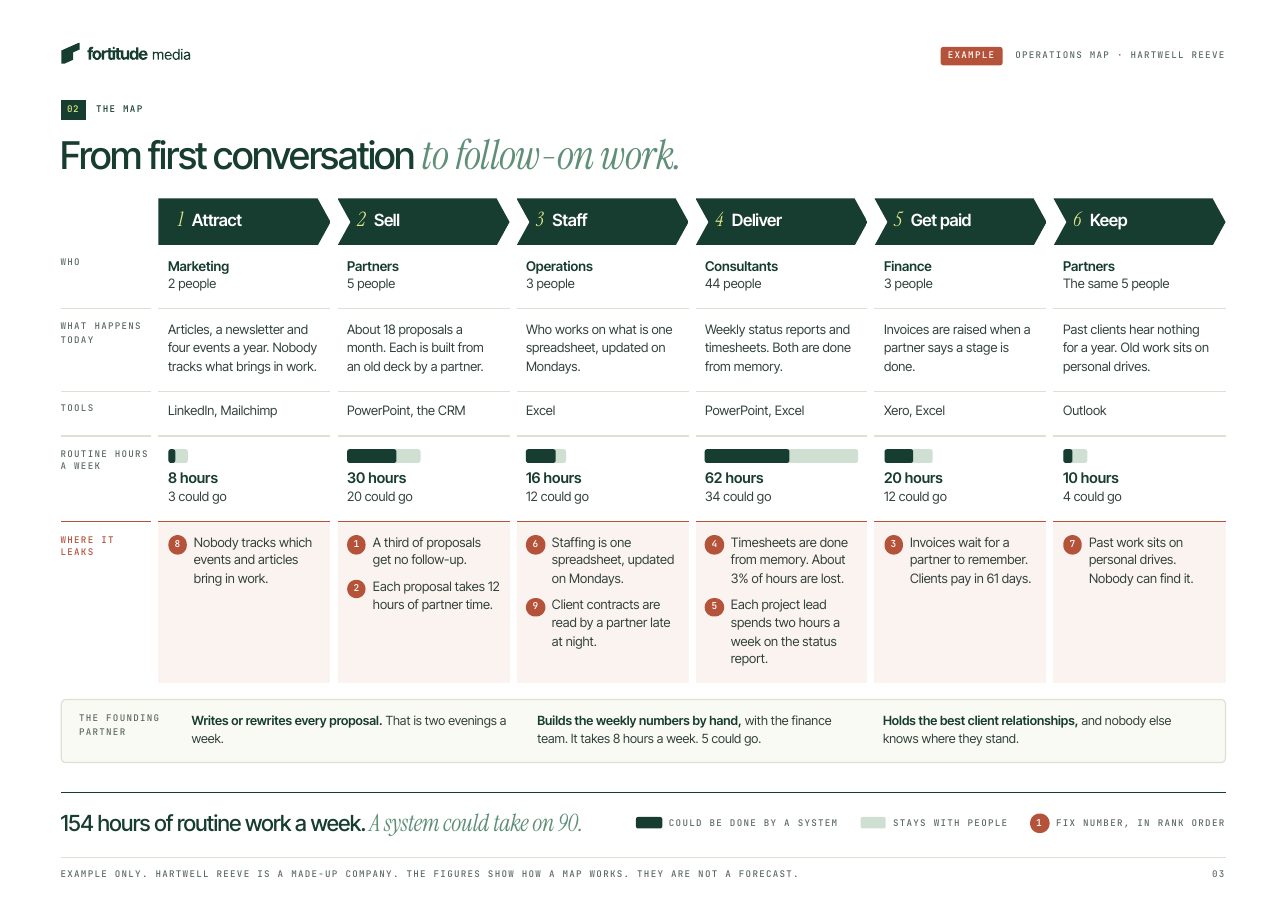
Both surveys come from firms that sell practice software, so use them as a prompt to count your own hours. When we map a firm we add up the routine work team by team. The example below is from our Business Operating System page. Penhallow Clarke is a made-up £14m commercial law firm with 120 people. The figures show how a map works and are not a forecast.
| Stage | Team | Routine hours a week | Hours a system could take on |
|---|---|---|---|
| Take on | Client onboarding, 6 people | 54 | 38 |
| Do the work | Fee earners and secretaries, 86 people | 120 | 64 |
| Bill | Billing team, 5 people | 60 | 40 |
| Get paid | Credit control, 3 people | 28 | 14 |
| Keep | Partners, 14 people | 12 | 4 |
Across the whole example firm the map found 290 hours of routine work a week, of which a system could take on 170. Our guide to finding where your team's time goes gives the method.
What can run on its own?
Five jobs: intake, engagement letters, onboarding and identity checks, billing and client updates. In each one the preparation can run without anyone asking. Anything that goes to a client or moves money waits for a person.
| Job | What a system does | What a qualified person still does |
|---|---|---|
| Intake and matter opening | Captures the enquiry, gathers the facts, searches your records for existing clients and related parties, opens the file | Decides whether to act, and decides on any conflict |
| Engagement letters | Fills your template with the client, scope, fee and terms | Sets the scope and fee, and approves the letter |
| Onboarding and identity checks | Requests documents, runs electronic checks through your provider, chases what is missing, records the result | Assesses the risk and decides whether to take the client on |
| Billing | Collects time entries, drafts the bill, raises it when approved, chases late payers on a schedule | Reviews the narrative and the amount, and approves it |
| Client updates | Drafts a status update from the file at each milestone | Approves it, and writes anything that contains advice |
| Reporting | Pulls the week's numbers into one page and flags what is stuck | Decides what to do about it |
There is early UK evidence on the gain. A Xero and Cebr study of 515 UK accountants and bookkeepers, published in November 2025, found that practices using AI completed the tasks concerned in 31% less time on average, saving the average practice 18 hours and 53 minutes a week. Xero sells accounting software, so read it as a vendor's finding.
The checking does not go away. Sage found that 54% of accountants who use AI regularly need to review or adjust what it produces. Plan for that time.
Identity checks need particular care. ICAS, which supervises its members for anti-money laundering, said in 2026 that firms cannot rely on Companies House identity verification to meet their own customer due diligence duties. A firm may use anti-money laundering software or an electronic identity provider for part of the work, but it must carry out due diligence on every client and keep the evidence. So the system can collect and check. A person must judge the risk.
What do the regulators say about confidentiality and conduct?
They say the same thing: you may use AI, your duties do not change, and you stay accountable for the work. None of them has banned it, and none has created a lighter standard for it.
| Regulator or body | What it has said | When |
|---|---|---|
| SRA, warning notice on the misuse of AI | Solicitors "remain accountable for their work and outputs, regardless of how that work has been prepared"; client information should go into AI systems only where contractual, technical and organisational safeguards protect it | August 2026 |
| SRA, Risk Outlook report on AI | Firms "cannot delegate accountability to an IT team or external provider" | November 2023 |
| ICAEW, AI and client data | Confidentiality duties under the Code of Ethics still apply when using AI; firms are expected to have policies on generative AI and to train staff | November 2026 |
| Tax professional bodies, including ICAEW, ICAS, ACCA and CIOT | New guidance on applying the tax conduct rules to AI tools, covering integrity, due care and client confidentiality | January 2026 |
| FCA, AI in financial services | Existing rules apply to firms' use of AI, and firms "remain responsible for consumer outcomes" | October 2026 |
Confidentiality is where firms are going wrong now. The SRA says it has identified cases of confidential client information being entered into public AI tools, and its notice quotes an Upper Tribunal decision that doing so with client letters "is to place this information on the internet in the public domain". The SRA adds that legal professional privilege may be permanently lost as a result. Carrie Langridge, who leads general, compliance and tax investigations at ICAEW, describes the same mistake among accountants as "like putting it on a virtual notice board".
Much of the risk comes from staff acting on their own. In the Thomson Reuters Future of Professionals survey of more than 1,800 professionals, published in June 2026, more than a third said they use AI tools their organisation has not sanctioned or in ways it cannot see. A ban does not fix that. An approved tool and a clear rule do.
In the systems we build, your data stays in your accounts and you approve which AI models see what. Anything that reaches a client or moves money is approved by a person, and every action is logged.
What must stay with a qualified person?
Advice, the decision to act, professional sign-off, anything put before a court or regulator, supervision and complaints. If a task needs a practising certificate, a signature or a professional judgement about risk, a person does it.
- Advice. The system can gather the facts and draft. The solicitor, accountant or adviser gives the advice and answers for it.
- Taking a client on. Conflict decisions and the risk assessment behind identity checks are judgements, and they belong to the firm.
- Sign-off. Accounts, tax returns, audit opinions and suitability reports carry a professional's name.
- Anything for a court. In Ayinde v London Borough of Haringey, decided in June 2025, the High Court said freely available AI tools "are not capable of conducting reliable legal research", and that lawyers who use AI for research have a professional duty to check it against authoritative sources.
- Supervision. The SRA's notice says those who supervise others remain accountable for work carried out through them.
- Complaints and bad news. These should come from a person.
The SRA's own decisions show where the line sits. When it authorised Garfield.Law in May 2025, the first purely AI-based law firm in England and Wales, it noted that the system takes a step only where the client has approved it and cannot propose case law, and that named solicitors remain accountable for everything it produces. Our guide to what should stay with people when AI does the routine work covers approval steps in more detail.
How do we start without putting clients at risk?
Start with non-billable admin in one team, set the rules before you build, and put the approval into the process from the first day.
Step 1: Count the routine hours in one team
Pick client onboarding or billing. List each recurring job, how often it happens and how long it takes. This gives you a baseline and shows which job to build first.
Step 2: Set the approved-tools rule
Write one page: which AI tools are approved, what may never be entered into any other tool, and who to ask. ICAEW expects firms to have such a policy and to review it regularly. Give staff an approved tool to use.
Step 3: Write down how each job is done today
A system can only follow a process that exists on paper. Write the steps for one job, including the exceptions, with the people who do it.
Step 4: Build the first job with the approval in it
Decide who approves each output before it reaches a client, and what they need to see to approve it quickly. Test it on closed files before live ones.
Step 5: Tell clients how you use AI
The SRA's 2023 report says firms should tell clients when AI will be used on their case and how it will operate, and leaves the method to the firm. A paragraph in the engagement letter is usually enough.
Step 6: Check, record and review
Have a supervisor sample the approved work each month. Keep the log. Review the policy and the process every quarter.
We run our own finance this way. The system raises the invoice when work is agreed and chases late payers on a schedule, a founder approves what is paid, and our accountant signs off the books. The rest is on how we run Fortitude.
What does it cost, and when is it not worth it?
It depends on how much routine work you have. Our prices are fixed and published on what it costs, so you can set them against the cost of the hours you counted.
| Item | Price | What you get |
|---|---|---|
| Operations Map and plan, one team | £2,999 | The routine hours counted, and a plan, in about three weeks |
| Operations Map and plan, whole firm | £7,500 to £15,000 | The same for every team, priced by size |
| Build, for each area | From £6,000 | One area built, tested and live, and yours to keep |
| Run | £2,500 to £5,000 a month | Watched, fixed and improved each month, with no minimum term |
It is not always worth it. A small practice with a few new clients a month may get more from tidying its templates than from building a system. Highly bespoke work has little routine in it to take away. And if you bill by the hour, be clear about which hours you are saving: every non-billable hour saved is a gain, while hours saved on chargeable work reduce what you bill unless your pricing changes. That is one reason to start with admin.
Cutting admin is half of the picture. The other half is how clients find and choose you, which we cover on our page for professional services firms and in our guides to which law firms ChatGPT recommends and which accountants it recommends.
What to do this month
- Ask one team, onboarding or billing, to list its recurring jobs and the time each takes.
- Write a one-page rule on approved AI tools and what must never be entered into public ones.
- Read your regulator's latest statement: the SRA's August 2026 warning notice, ICAEW's November 2026 note on client data, or the FCA's October 2026 review.
- Pick one non-billable job and write down how it is done today, exceptions included.
- Decide who will approve each output, and what you will tell clients.
To see what a map would find in a firm like yours, book a conversation: 30 minutes with a founder, at no charge.
Frequently asked questions
Can we put client information into ChatGPT?
Not into a public or free tool. The SRA says client information should be entered into AI systems only where contractual, technical and organisational safeguards protect it, and ICAEW treats entering confidential information into open tools as a possible breach of its Code of Ethics. Use a tool your firm has approved, under terms you have read.
Who is responsible if the AI gets something wrong?
You are. The SRA's warning notice says the use of AI "does not diminish or transfer your professional responsibilities". The FCA says regulated firms remain responsible for consumer outcomes. This is why a named person approves anything that leaves the firm.
Can a system do our identity checks?
It can request documents, run electronic checks through a provider, chase and record. Your firm stays responsible for customer due diligence and for judging the risk. ICAS has said firms cannot rely on Companies House identity verification in place of their own checks.
Do we have to tell clients we use AI?
The SRA's 2023 report says firms should tell clients when AI will be used on their case and how, and that the way you do it is for the firm to decide. We would put a short, plain paragraph in the engagement letter.
We are FCA-regulated. Do different rules apply?
No separate AI rulebook applies. The FCA's October 2026 review says its existing rules cover firms' use of AI, including the Consumer Duty and the Senior Managers and Certification Regime, and gives examples of good and poor practice. If your professional body has its own rules, raise them when we speak.
Will automating admin reduce our billable hours?
Not if you start with non-billable work. Intake, onboarding, billing and updates are mostly time you cannot charge for. Saving it frees fee earners for chargeable work or for clients.
Sources
- Legal Support Network, Legal professionals lose nearly 18 weeks a year to non-billable work: LEAP, Profitability in Law 2026 (March 2026)
- Sage, The hidden hours of accountancy: Sage research (June 2026)
- Xero, Accounting sector profits surge with AI adoption (November 2025)
- ICAS, Reliance on Companies House verification for AML customer due diligence (April 2026, updated June 2026)
- Solicitors Regulation Authority, Misuse of AI: warning notice (August 2026)
- Solicitors Regulation Authority, Risk Outlook report: the use of artificial intelligence in the legal market (November 2023)
- Solicitors Regulation Authority, SRA approves first AI-driven law firm (May 2025)
- ICAEW, AI and client data: complying with the principle of confidentiality (November 2026)
- ICAEW, Professional bodies issue AI advice to members (January 2026)
- Financial Conduct Authority, AI in financial services: good practice and areas for improvement (October 2026)
- Thomson Reuters Institute, Future of Professionals 2026: As AI adoption grows, so do the challenges (June 2026)
- The National Archives, R (Ayinde) v London Borough of Haringey, High Court judgment (June 2025)