










On this page · 9 sections
- What does the research say about AI project success rates?
- Why do AI pilots stall?
- Is the problem the technology or the way it was bought?
- When should a pilot be stopped instead of rescued?
- How do you take one area to live use?
- How do you know it is live and not still a pilot?
- What to do this month
- Questions founders ask
- Sources
Six months ago somebody on your team got an AI pilot going. It might have been a chatbot on the help pages, a tool that drafts proposals, or assistant licences for the sales team. The demonstration went well. Since then, nothing. It is still "in pilot", three people use it, and the board keeps asking about your AI plan.
You are in the majority. A report from MIT's NANDA initiative, covered by Fortune in August 2025, found that about 5% of generative AI pilots achieved rapid revenue growth and that the rest stalled, with little or no measurable effect on profit. In the UK, the Office for National Statistics said in July 2026 that adoption has been "relatively shallow": about 35% of businesses with ten or more employees use AI, but the average adopter uses only around 1.6 AI technologies.
The reasons are well documented, and few of them are about the technology. This guide sets out what the published research says about AI project success rates, the four reasons pilots stall, when a pilot should be stopped, and how to take one area of the business to live use.
What does the research say about AI project success rates?
Most projects do not reach live use or a measurable return, but the well-known figures count different things. Read the last column before quoting any of them to your board.
| Source | What it found | What it counted |
|---|---|---|
| MIT NANDA, reported by Fortune (August 2025) | About 5% of generative AI pilots achieved rapid revenue growth | Measurable effect on profit and loss, from 150 interviews, a survey of 350 employees and 300 public deployments |
| RAND (August 2024) | "By some estimates, more than 80 percent of AI projects fail", twice the rate of IT projects without AI | Other researchers' estimates, plus RAND's own interviews with 65 data scientists and engineers |
| S&P Global Market Intelligence, reported by CIO Dive (March 2025) | 42% of companies abandoned most of their AI initiatives, up from 17% a year earlier; the average organisation scrapped 46% of proofs of concept | Abandonment, from more than 1,000 respondents in North America and Europe |
| Gartner (February 2025) | Through 2026, organisations will abandon 60% of AI projects not supported by AI-ready data | A prediction, alongside a survey of 1,203 data management leaders |
| Deloitte, reported by Techstrong (January 2026) | Only about a quarter of organisations have moved 40% or more of their AI pilots into production | Pilots reaching production |
Three cautions. The MIT figure sets a high bar: a pilot that saves time but does not move profit counts as stalled. Gartner's figure is a forecast, not a count. And most of these surveys describe large enterprises, not firms with £5m to £100m in sales.
The pattern is still consistent across all five: getting a pilot started is easy, and getting it into daily use is where most stop.
Why do AI pilots stall?
For four reasons, and the model is rarely one of them. Fortune's summary of the MIT report puts the core issue as a "learning gap" in tools and organisations, not the quality of the AI models. RAND's interviews found the most common cause of failure was misunderstanding about what the project was for.
Nobody owns the result
A pilot usually belongs to whoever was keenest, or to IT. It does not belong to the person whose targets depend on the job being done. When that enthusiast gets busy, the pilot stops moving.
RAND's advice to leaders is blunt: before starting, be prepared to commit a team to solving one specific problem for at least a year. Management matters here more than technology. The ONS's management practices survey found that 37% of the best-managed tenth of UK firms had tested or adopted AI in 2023, against 3% of the worst-managed tenth.
The process did not change
The tool was added beside the work, not into it. To use it, people leave the system they work in, paste something into a chat window, and copy the answer back. That is an extra step, and under pressure people skip extra steps.
Fortune reports the MIT researchers' view that generic tools work well for individuals but stall in company use because they do not learn from or adapt to workflows. Deloitte's 2026 survey, as reported by Techstrong, found approved AI tools now reach roughly 60% of workers, with underuse even among those who have them. Access is not the same as a changed process.
The data was not ready
Gartner found that 63% of organisations either lack the right data management practices for AI or are unsure whether they have them. RAND lists a lack of suitable data as the second root cause of failure.
In a mid-sized firm, "data" is rarely a data science problem. It means customer records in three systems that disagree, templates in one person's folder, and prices in a spreadsheet. A pilot shown on clean examples meets the real records and gives wrong answers. Trust goes, and it does not come back quickly.
You measured the tool, not the outcome
Pilots are judged on logins, prompts and minutes saved. None of those is a business result.
The UK government's own trials show the gap. In a cross-government experiment with 20,000 staff, users of Microsoft 365 Copilot reported saving an average of 26 minutes a day. The Department for Business and Trade's evaluation of its own pilot "did not find robust evidence to suggest that time savings are leading to improved productivity", while noting that productivity was not a key aim of the study.
An outcome is something a customer or the finance director would notice: invoices sent the day work is agreed, enquiries answered within the hour, a new client set up in two days instead of ten.
Is the problem the technology or the way it was bought?
Mostly the way it was bought. Fortune reports the MIT finding that buying AI tools from specialist vendors and building partnerships succeeded about 67% of the time, while internal builds succeeded only one-third as often. The same report found more than half of generative AI budgets going to sales and marketing tools, while the biggest returns came from back-office automation.
We build and run these systems for a living, so weigh our view accordingly. The MIT figures are not ours. The routes below are the ones we see founders choose.
| Route | What you get | Where it tends to stall |
|---|---|---|
| Licences for everyone | A general assistant on every desk, quickly | Individuals save minutes; no process changes and nothing is measured |
| An in-house build | Something made for your firm by people who know it | Built alongside day jobs, and half-finished when the person who built it moves on |
| A consultancy review | A long review and a thick report | Recommendations your team then has to build |
| A specialist build, then run | One area built into your systems and kept working | Still fails without an owner inside the firm |
None of these is wrong in itself. Licences are a reasonable way to let people learn. The mistake is expecting any of them to turn into a live system without an owner, a changed process and a number.
When should a pilot be stopped instead of rescued?
When the job was a poor fit from the start. RAND's fifth root cause is the plainest: projects fail when the technology is applied to problems too difficult for AI to solve, and "AI is not a magic wand".
Stop the pilot, and say so, when any of these is true:
- The job is mostly judgement. Deciding whether to take on a client, how to handle a complaint, or what to charge is not routine work.
- The volume is too low. A task done five times a month will not repay the build, however dull it is.
- Mistakes are costly and hard to spot. If nobody can check the output quickly, a person should keep doing the work.
- The process is about to change. Automating a job on a system you are replacing next year is building twice.
- Nobody will own it. A pilot without an owner inside the firm does not need rescuing. It needs ending.
Stopping a pilot frees the budget and the goodwill for a job that does fit.
How do you take one area to live use?
Choose one area, name one owner and one number, build it into the systems people already use, and switch the old way off on a set date. The method below is how we approach it.
Step 1: Pick one area with volume and rules
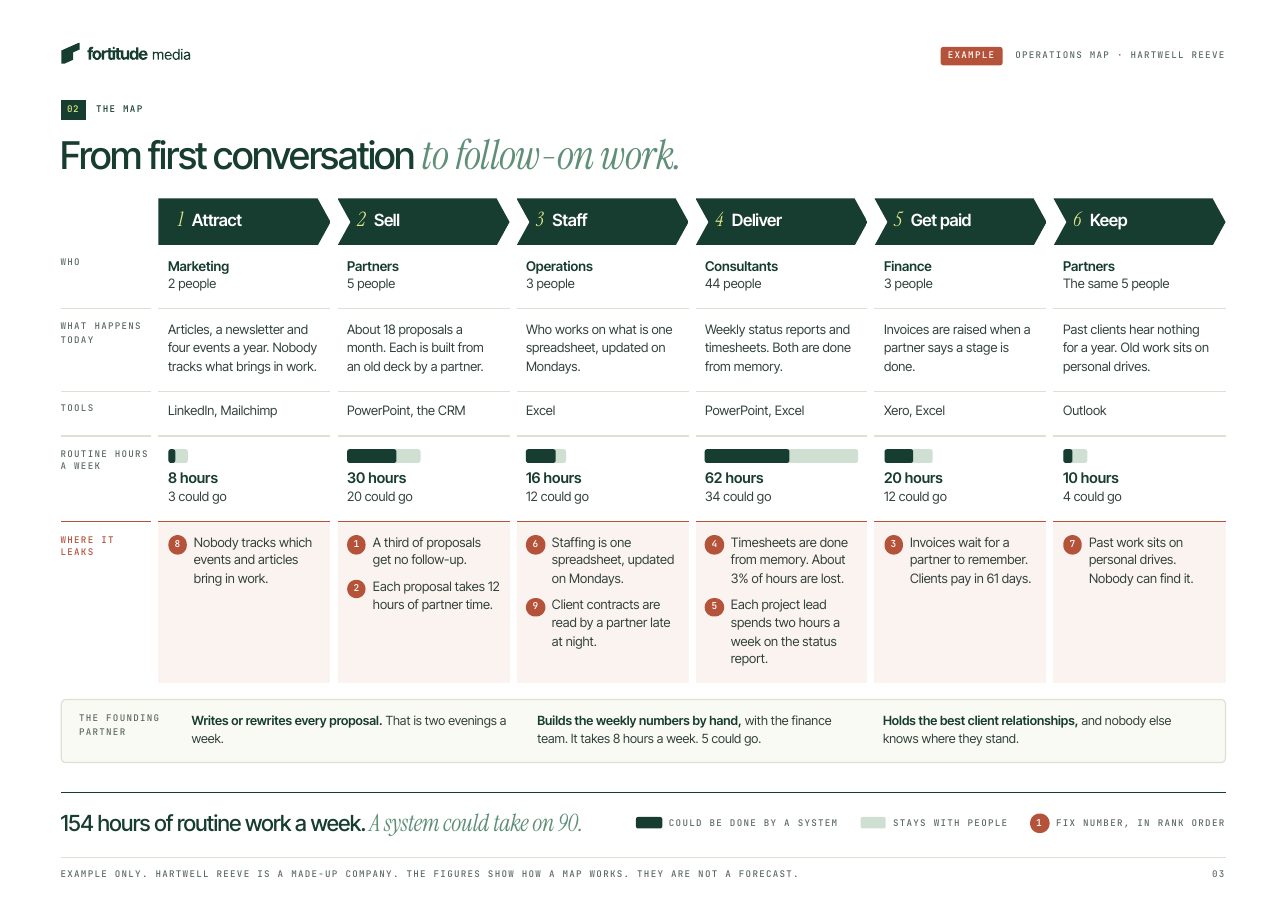
Choose work that happens many times a week and follows rules you could write down: raising invoices, answering common questions, setting up new clients. If you do not know where the hours are, map them first; how to find out where your team's time goes shows how.
Step 2: Name one owner and one number
The owner is the person who runs that area today, not the person who likes the technology. The number is an outcome they already care about. Write both down before anything is built.
Step 3: Write down how the job is done now
Sit with the people who do it and record every step, including the exceptions. This is the part most pilots skip. You cannot hand a job to a system when the method lives in three people's heads.
Step 4: Fix the data this job needs, and only that
If the job is invoicing, clean the client records and the price list. Leave the rest. A firm-wide data project before any automation is how a three-month job becomes a two-year one.
Step 5: Build it into the systems people already use
The work should start where it starts today, in your customer, finance or practice system. Keep a person in charge: anything that reaches a customer or moves money is approved by someone, and every action is logged. The UK government's AI Playbook makes the same point in its fourth principle: "You have meaningful human control at the right stages".
Step 6: Run it beside the old way, then switch
Run the new way and the old way together for a few weeks and compare the results. Then set a date on which the old way stops. Without that date, the pilot stays a pilot.
Step 7: Keep somebody watching it
Systems drift. Templates change, a supplier changes a format, a new service is added. Someone has to watch the number, fix what breaks and improve it each month.
In our own work the map and plan take about three weeks, a build takes four to eight weeks for each area, and the first area is live seven to eleven weeks after we start. A build is from £6,000 for each area and running it is £2,500 to £5,000 a month, with no minimum term; the full list is on what it costs. How the parts fit together is on our Business Operating System page.
How do you know it is live and not still a pilot?
Three tests. It is the normal way the job gets done, not an option. A named person owns it. And its number appears in the weekly report alongside sales and cash.
| A pilot | Live use | |
|---|---|---|
| Who uses it | Volunteers | Everyone who does the job |
| The old way | Still running | Switched off on a set date |
| Owner | The enthusiast, or IT | The person who runs the area |
| Measure | Logins and minutes saved | An outcome the business already tracks |
| When it breaks | Nobody notices for a week | Somebody is watching and fixes it |
We hold ourselves to the same tests. Seven parts of our own firm run this way today and two more are next, built one at a time, starting where it paid back fastest. How we run Fortitude lists each one, with what the system does and what a person still does.
What to do this month
- List every AI pilot and licence the firm is paying for, with who owns each and what it was meant to change.
- For each, write the outcome it should move. If you cannot name one, stop it.
- Pick the one area with the most volume and the clearest rules, and name its owner.
- Sit with the team and write down how the job is done today, exceptions included.
- Set two dates: when the new way starts running beside the old, and when the old way stops.
- Put the outcome number in your weekly report from the first day.
If you want a second opinion on which pilot to rescue and which to stop, book a conversation: 30 minutes with a founder, at no charge.
Frequently asked questions
Is the "95% of AI pilots fail" figure reliable?
It is a fair summary of one study with a high bar. Fortune reports that the MIT NANDA research drew on 150 interviews, a survey of 350 employees and 300 public deployments, and found about 5% of pilots producing rapid revenue growth. Other studies, counting abandonment, give lower failure rates. All of them agree that most pilots do not reach daily use.
Should we wait until the tools improve?
Waiting does not fix the four causes, because none of them is about the tool. An owner, a written process, clean records for one job and an outcome measure are all work you can do now, and they will be needed whichever tool you choose. We made the same case for AI search in can we wait a year?.
Do we need to sort out all our data first?
No. Fix the data one job needs, take that job live, then move to the next. Gartner's warning is about projects unsupported by suitable data, not a call to clean everything before you begin.
Should we build it ourselves or buy it in?
The MIT research, as reported by Fortune, found bought or partnered projects succeeding about three times as often as internal builds. Some areas still suit your own team, especially where the work is simple and somebody has the time. A good plan says which is which.
How do we explain a stalled pilot to the board?
Plainly. Say what it was meant to change, why it did not, and what you will do differently: one area, one owner, one number, and a date. Our guides to an AI plan for the board and getting a board to approve AI budget cover the format.
Will taking AI live mean losing people?
Most firms use it to grow without adding headcount at the same rate, not to cut. The ONS found in July 2026 that AI use to improve operations "has not yet translated into widespread changes in overall workforce headcount". The routine work goes; the judgement, the relationships and the approvals stay with people.
Sources
- Fortune, MIT report: 95% of generative AI pilots at companies are failing (August 2025)
- RAND, The root causes of failure for artificial intelligence projects and how they can succeed (August 2024)
- CIO Dive, AI project failure rates are on the rise: report (March 2025)
- Gartner, Lack of AI-ready data puts AI projects at risk (February 2025)
- Techstrong, Deloitte's AI in 2026 report: enterprises scale AI, yet real gains lag (January 2026)
- Office for National Statistics, Artificial intelligence in UK businesses: 2023 to 2026 (July 2026)
- Office for National Statistics, Management practices in the UK: 2016 to 2023 (May 2024)
- Government Digital Service, Microsoft 365 Copilot experiment: cross-government findings report (June 2025)
- Department for Business and Trade, The evaluation of the M365 Copilot pilot (August 2025)
- GOV.UK, Artificial Intelligence Playbook for the UK Government (February 2025)