










On this page · 9 sections
The finance team says it needs another credit controller. Sales wants an administrator. Customer service wants two more people before the busy season. Each request is reasonable, and each comes with a salary you can see.
What you cannot see as easily is the full cost of each hire, or what the same work would cost if a system did the routine part of it. Both can be worked out. Employer costs follow published rates: National Insurance at 15% on earnings above £5,000 a year in 2026 to 2027 (GOV.UK), and a pension contribution of at least 3% of qualifying earnings (GOV.UK). Automation is harder to price, because the tools are cheap and the work around them is not.
This guide sets the two side by side: the full cost of a UK hire, the set-up and running costs of automating an area of the business, how to work out payback, and where hiring is still the right answer. Our own prices are on what it costs.
What does a UK hire really cost?
About 15% more than the salary in employer National Insurance and minimum pension, then recruitment, equipment and management time on top. The table works through three salaries using 2026 to 2027 rates.
| Sales administrator, experienced | Credit controller, experienced | Median full-time employee | |
|---|---|---|---|
| Salary | £28,000 | £32,000 | £40,911 |
| Employer National Insurance, 15% above £5,000 | £3,450 | £4,050 | £5,387 |
| Minimum employer pension, 3% of qualifying earnings | £653 | £773 | £1,040 |
| Yearly cost before anything else | £32,103 | £36,823 | £47,338 |
| Recruitment, CIPD median | £2,000 | £2,000 | £2,000 |
| First-year cost | £34,103 | £38,823 | £49,338 |
The salaries come from the National Careers Service, which puts an experienced sales administrator at £28,000 and an experienced credit controller at £32,000, and from the Office for National Statistics, which put median gross annual earnings for full-time employees at £40,911 in April 2026. Qualifying earnings for the pension are those between £6,240 and £50,270 a year. The sums are ours.
The recruitment figure is from the CIPD's 2026 resourcing survey of 1,014 HR professionals. It found a median cost per hire of £2,000 for employees below senior level, up from £1,500 in 2024, and £5,000 for senior managers in the private sector. That covers advertising, agency fees, in-house time, testing and onboarding. The CIPD warns that the samples are small.
Four further costs do not appear in the table.
- The Apprenticeship Levy. GOV.UK's rates page puts it at 0.5% of the pay bill with a £15,000 allowance, so it applies once the pay bill passes £3m. A firm of 100 people on median pay is over that line, which adds about £140 to £205 a year to each role above.
- The Employment Allowance does not help with the next hire. The allowance takes up to £10,500 off an eligible employer's National Insurance bill for the year. A firm of 50 or more uses that up many times over, so every extra person costs the full 15%.
- Equipment, software and space. Add your own figures for a laptop, licences, a desk and training.
- Management time. For example, a manager on £60,000 costs about £69,600 with National Insurance and pension, or roughly £41 for each hour worked. Three hours a week spent directing a new team member comes to about £5,500 a year.
For marketing and sales roles, we have set out the same sums in fractional CMO, agency or in-house and in-house SDR or outsourced outbound.
How many hours do you get for that?
About 1,700 a year. There are 260 weekdays in a year. A full-time worker is entitled to 5.6 weeks of paid leave, which is 28 days and can include bank holidays (GOV.UK). The average worker lost 4.4 days to sickness in 2025 (ONS). That leaves about 228 working days, or roughly 1,700 hours at 7.5 hours a day.
Divide the yearly cost by those hours and the sales administrator costs about £19 for each hour worked, the credit controller about £22 and the median employee about £28, before recruitment and management.
Two things follow. A person is on duty for 37.5 of the 168 hours in a week. And not every hour is spent on the job you hired for: meetings, handovers and waiting take their share. A system has neither limit, though it has limits of its own, which we come to below.
What does automating an area cost?
Very little for the tools, and a meaningful amount for finding the work, building the system and keeping it running. Most of the bill is people's time, yours or a specialist's.
The tools first. Microsoft lists its 365 Copilot Business add-on at £16.10 a user a month before VAT when paid yearly, on top of a Microsoft 365 Business plan, with a first-year offer of £13.80 when we checked in November 2026. At the full price that is £19,320 a year for 100 people. If you build your own automations on a model directly, Anthropic's published API prices are $2 per million input tokens and $10 per million output tokens for Claude Sonnet 5.5, and $0.10 and $0.50 for the smaller Claude Haiku 5.5 on prompts of up to 100,000 tokens.
Tools alone rarely change the cost base. The government's AI adoption survey of 3,503 UK businesses found that cost matters mainly as the time, effort and resources needed to put AI to work, not the price of the tools. Of the businesses able to estimate their spending, 47% had spent nothing on AI in 2025. Asked about operating costs, 64% had seen no immediate financial effect.
So the real choice is who does the set-up and the running.
| Cost | Your own team | With a specialist, at our published prices |
|---|---|---|
| Finding the routine work | Managers' time | Operations Map and plan: £2,999 for one team, £7,500 to £15,000 for the whole business |
| Building | Your people's time alongside their day jobs, plus tools | From £6,000 for each area, built in four to eight weeks |
| Running | Someone to watch it, fix it and improve it | £2,500 to £5,000 a month, priced by number of areas, no minimum term |
| Software | Licences and usage | Your own software subscriptions are extra, as is VAT |
| Main risk | It stalls when the builder is busy or leaves | The monthly fee continues for as long as you want it run |
On the first route, bear in mind the MIT NANDA study reported by Fortune in August 2025: projects bought from specialist vendors or built in partnership succeeded about 67% of the time, and internal builds about a third as often. Why AI pilots stall looks at the reasons.
How do the two compare over a year?
For one person's worth of routine work, they cost about the same. The gap opens when an area holds more routine work than one person can do, or work that arrives outside office hours.
| One hire at £28,000 | One area automated, at our lowest published prices | |
|---|---|---|
| Year one | About £34,100 | From about £36,000: a £6,000 build and twelve months' running at £2,500 |
| Each later year | About £32,100 | From £30,000 |
| Capacity | About 1,700 hours a year, in working hours | Whatever routine work the area holds, at any hour |
| What it cannot do | Work two jobs at once | Judgement, relationships, anything outside its rules |
The Operations Map fee is not in that column because paid steps are credited against the next one. Your own software subscriptions would add to it.
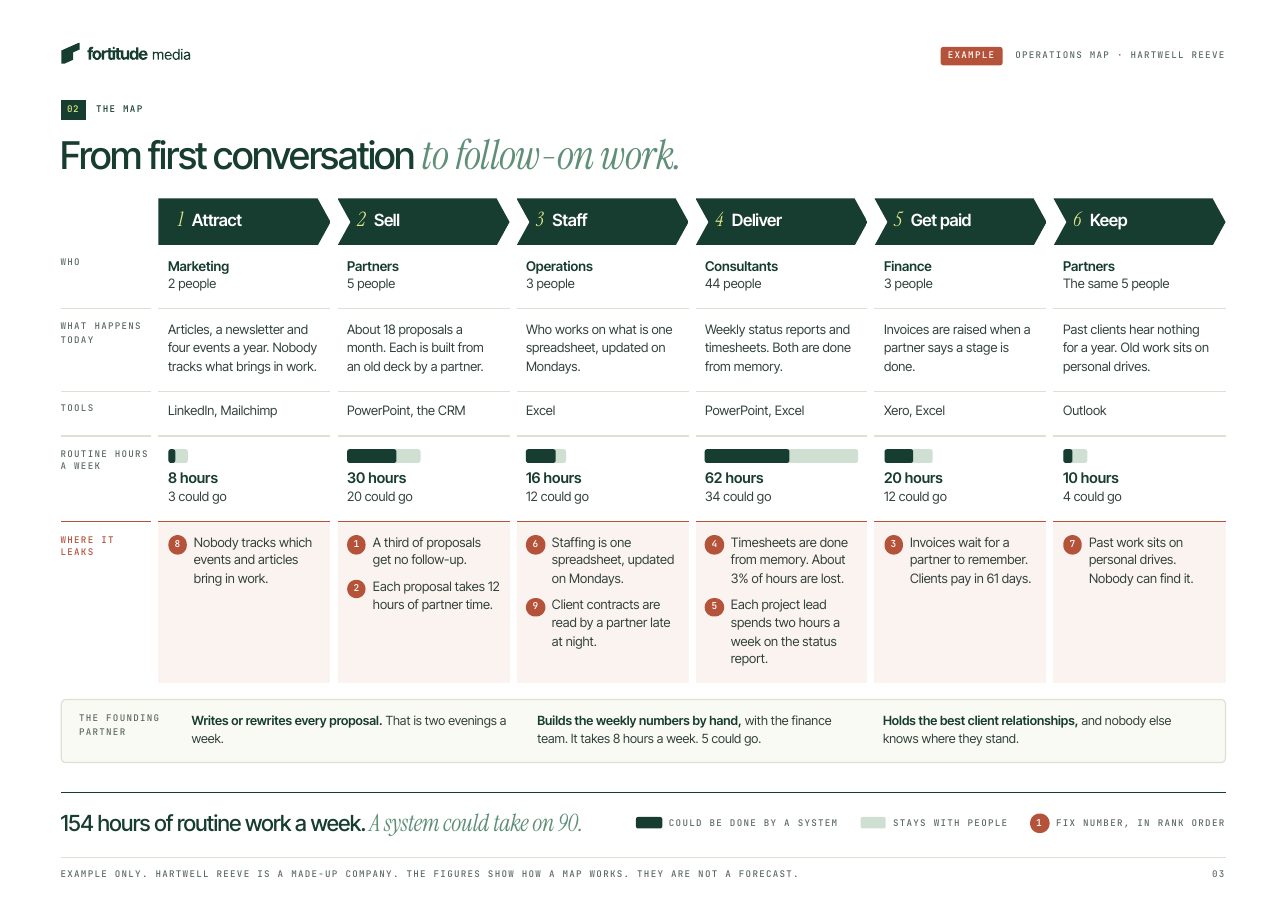
Scale changes the picture. The example on our Business Operating System page uses a made-up commercial law firm with 130 hours of routine work a week across its teams. Covering that with people takes 3.5 more full-time staff at £187,000 a year. Covering it with a system costs £54,000 a year to run, after builds of £26,000. Those figures come from an invented firm. They show how the sum works and are not a forecast for yours.
One caution. A saving is only real if you would otherwise have hired, or if the freed time turns into paid work. Three hours a week returned to each of thirty people is 90 hours, but it removes nobody's salary. Decide in advance what the time is for.
How do we work out payback for our own firm?
Count the routine hours, price them at full cost, and compare with a year of set-up and running. An afternoon with your finance lead is enough for a first pass.
Step 1: Count the routine hours in one area
List the tasks that repeat and follow rules, and the hours a week each takes. Which jobs to automate first gives a way to score them.
Step 2: Price the hours at full cost
Take the yearly cost of the people doing the work, with National Insurance and pension, and divide by 1,700 for an hourly figure. Or convert the hours to full-time roles: 37.5 routine hours a week is one role.
Step 3: Decide what happens to the freed time
An avoided hire counts. Time moved to fee-earning work counts. Time that simply disappears into the week does not.
Step 4: Add up a year of automation
Include the build, twelve months of running, your own software subscriptions and the time your people will spend approving the output.
Step 5: Work out the months to pay back
Subtract the monthly running cost from the monthly saving, and divide the build cost by what is left.
For example, take a finance team with 40 hours of routine work a week that a system could take on. That is just over one full-time role, or about £39,300 a year at a credit controller's full cost. Against running costs of £30,000 a year, the net saving is about £9,300, and a £6,000 build takes about eight months to pay back. With 80 routine hours a week the people cost is about £78,600, the net saving about £48,600, and the same build is repaid in under two months. These sums use our lowest published prices and leave out your own software subscriptions. A larger area may cost more to build and run.
Where is hiring still the right answer?
Wherever the work needs a person, and wherever there is too little routine work to justify building anything.
- Skilled work clients pay for. A system does not give the advice, run the workshop or place the candidate.
- Relationships. Clients want a named person who knows them.
- Small volumes. If an area holds less than one person's worth of routine work, the running cost will exceed the saving. Hire part-time, or leave it.
- Unsettled processes. If nobody can write down how the job is done, a person will cope and a system will not.
- Owning the system. Even an automated area needs someone to approve what goes out and to notice when it is wrong.
Hiring is also getting harder to plan. In the CIPD survey most employers expected the Employment Rights Act 2025 to raise employment costs, and 26% expected to recruit fewer workers as a result.
We made this choice in our own firm. Five of us do the work that took about 30 people at our previous companies, with an extended team to call on when a client needs one, and how we run Fortitude shows what the system does and what a person still does in each area.
What to do this month
- List the roles you plan to hire or replace in the next twelve months.
- Work out the full first-year cost of each: salary, National Insurance, pension, recruitment, equipment and management time.
- For each role, estimate how many hours a week are routine and follow rules.
- Add up the routine hours by area, not by role.
- For the largest area, compare a year of people cost with a year of set-up and running.
- Decide what the freed time would be used for before you spend anything.
If you would like the sums checked, book a conversation: 30 minutes with a founder, at no charge, and you leave with three areas a system could take on, in writing.
Frequently asked questions
Is automation cheaper than hiring?
Only above a certain volume. At our lowest published prices, one automated area costs about the same in a year as one junior hire. It becomes cheaper when the area holds more routine work than one person can do, and it is dearer when it holds less.
What does an AI tool licence cost?
Less than most founders expect. Microsoft lists its 365 Copilot Business add-on at £16.10 a user a month before VAT, paid yearly. Model usage bought directly is priced per million tokens, at $2 for input and $10 for output on Claude Sonnet 5.5. The larger costs are building and running the system.
Does the Employment Allowance reduce the cost of a new hire?
Not in a firm your size. The allowance is worth up to £10,500 a year against the whole firm's employer National Insurance. A firm with 50 or more staff uses it up early in the year, so each extra person costs the full 15% above £5,000.
How quickly does each option start working?
On our timings a first area is live seven to eleven weeks after the start: about three weeks to map and plan, then four to eight weeks to build. A hire has to be advertised, interviewed and trained, and may have notice to serve elsewhere first.
What if the system does not deliver?
Agree in advance what it should save and how you will count it. Our own monthly service has no minimum term and can be cancelled on 30 days' notice, and you keep everything that was built. We will also consider results-based terms where the number is agreed up front and we can measure it ourselves.
Can we automate first and hire later?
Yes, and it is often the better order. Take the routine work out of a role, see what is left, and hire for that. You may find the remaining job is more senior, and more interesting, than the one you were going to advertise.
Sources
- GOV.UK, Rates and thresholds for employers 2026 to 2027 (updated September 2026)
- GOV.UK, Workplace pensions: what you, your employer and the government pay (checked November 2026)
- Office for National Statistics, Employee earnings in the UK: 2026 (October 2026)
- National Careers Service, Sales administrator job profile (checked November 2026)
- National Careers Service, Credit controller job profile (checked November 2026)
- CIPD, Resourcing and talent planning report 2026 (September 2026)
- GOV.UK, Employment Allowance (checked November 2026)
- GOV.UK, Holiday entitlement (checked November 2026)
- Office for National Statistics, Sickness absence in the UK labour market: 2025 (May 2026)
- Microsoft, Microsoft 365 Copilot pricing (checked November 2026)
- Anthropic, Claude API pricing (checked November 2026)
- GOV.UK, AI adoption survey report 2026: executive summary (October 2026)
- Fortune, MIT report: 95% of generative AI pilots at companies are failing (August 2025)