










On this page · 10 sections
- What does growing without growing headcount actually mean?
- How do we measure it?
- Why does headcount track revenue in service firms?
- Which work scales with people, and which does not?
- Is this really happening, or is it hype?
- What should we change first?
- When is hiring still the right answer?
- What to do this month
- Questions founders ask
- Sources
You doubled revenue, and you nearly doubled the team to do it. Margin is about where it was five years ago, the wage bill is the biggest line in the accounts, and the plan for the next £10m has a hiring plan attached.
That pattern is normal in firms that sell skilled people's time. It is also getting dearer. Employers pay National Insurance at 15% on earnings above £5,000 a year in 2026 to 2027 (GOV.UK), and the CIPD's 2026 resourcing survey put the median cost of recruiting an employee below senior level at £2,000, up from £1,500 in 2024.
This guide is about loosening the link between revenue and headcount: how to measure it with one number, why it is so tight in service firms, which work has to grow with people and which does not, and what to change first.
What does growing without growing headcount actually mean?
It means revenue rises faster than the number of people, so revenue per employee goes up each year. It does not mean a hiring freeze, and it rarely means a smaller team.
The firms doing this best are still hiring. PwC's 2026 Global AI Jobs Barometer, which combines more than a billion job adverts with company financial data, found that companies in the sectors most exposed to AI recorded 34% labour productivity growth between 2018 and 2025, against 24% in the least exposed. Their headcount grew too, by 52% against 36%. They added people and got more from each one.
So the aim is a ratio, not a cut. If revenue grows 20% and headcount grows 8%, the firm has become easier to run and more profitable to own.
How do we measure it?
Divide the year's revenue by the average number of full-time-equivalent people on the payroll, and track it over three years. Count contractors who do the work of staff. If you pass large costs straight through to clients, use gross profit in place of revenue.
Outside benchmarks are rough, but they give a sense of scale.
| Benchmark | Figure | Source |
|---|---|---|
| UK small businesses, 10 to 49 employees | About £170,000 turnover per person | Business population estimates 2026, our arithmetic |
| UK medium-sized businesses, 50 to 249 employees | About £254,000 turnover per person | Business population estimates 2026, our arithmetic |
| UK large businesses, 250 or more employees | About £244,000 turnover per person | Business population estimates 2026, our arithmetic |
| Law firms, median fees per fee earner | £162,060 | Law Society Financial Benchmarking Survey 2026 |
The first three rows come from the government's business population estimates, published in November 2026. At the start of 2026 there were 39,220 medium-sized businesses with 3.8 million people and £965bn of turnover between them. Dividing one by the other is our sum, not an official benchmark. The figures cover every sector except finance, so they include wholesalers and manufacturers with high turnover and thin margins, and the release calls its employment numbers indicative.
Your own trend matters more than any of these. For the economy as a whole the gains are slow: the ONS put output per hour worked in July to September 2026 at 8.8% above its 2019 average. Gains of this kind come slowly unless something changes in how the work is done.
Why does headcount track revenue in service firms?
Because you sell hours, and every hour sold brings unsold hours with it. Each new client needs skilled people to do the work, and each skilled person needs support, supervision and coordination.
The Law Society's Financial Benchmarking Survey 2026, covering 121 firms in England and Wales, shows the shape of it. In 2025 the median firm spent 63.9% of fee income on salaries. Support staff cost £27,061 for every fee earner, up from £25,655 a year earlier. Firms employed 0.44 secretaries and 0.35 other support staff for each fee earner. Add a fee earner, and most of another support role follows.
Three things keep the link tight.
- Delivery is made of hours. A client pays for skilled time, and a person has only so much of it.
- Coordination grows faster than the work. More clients mean more handovers, more status updates and more chasing. Microsoft's 2025 Work Trend Index found from its own usage data that employees are interrupted every two minutes during the working day, and 80% of the people it surveyed said they lack the time or energy to do their work.
- Hiring is the habit. When a team is stretched, a new role is the answer everybody understands. Nobody asks whether the stretch is skilled work or routine work.
The link can bend. In the same Law Society survey, median fee income rose 11.2% in 2025 while the number of fee earners rose 2.3%.
Which work scales with people, and which does not?
Skilled work, relationships and judgement scale with people. Routine work that follows rules does not have to. The useful exercise is sorting your own firm's hours into the two columns.
| Work | Has to grow with people? | Why |
|---|---|---|
| Skilled delivery: advice, design, analysis, placing candidates | Yes | It is what clients pay for |
| Client relationships and difficult conversations | Yes | Trust is personal |
| Judgement and sign-off: pricing, complaints, hiring, anything regulated | Yes | Someone has to be accountable |
| Finding and researching prospects, drafting first approaches and follow-ups | No | The steps repeat, and a person can approve the result |
| Raising invoices and chasing late payers | No | It follows a schedule |
| Onboarding steps, status updates and handovers between teams | No | It follows a checklist |
| Pulling the weekly numbers together | No | The data already exists in your tools |
The second group is larger than most founders expect. McKinsey's 2023 study of generative AI estimated that existing technology could automate work activities that absorb 60 to 70% of employees' time. That is technical potential, not a forecast, and no firm gets near it in practice. It does show how much of a working week follows rules.
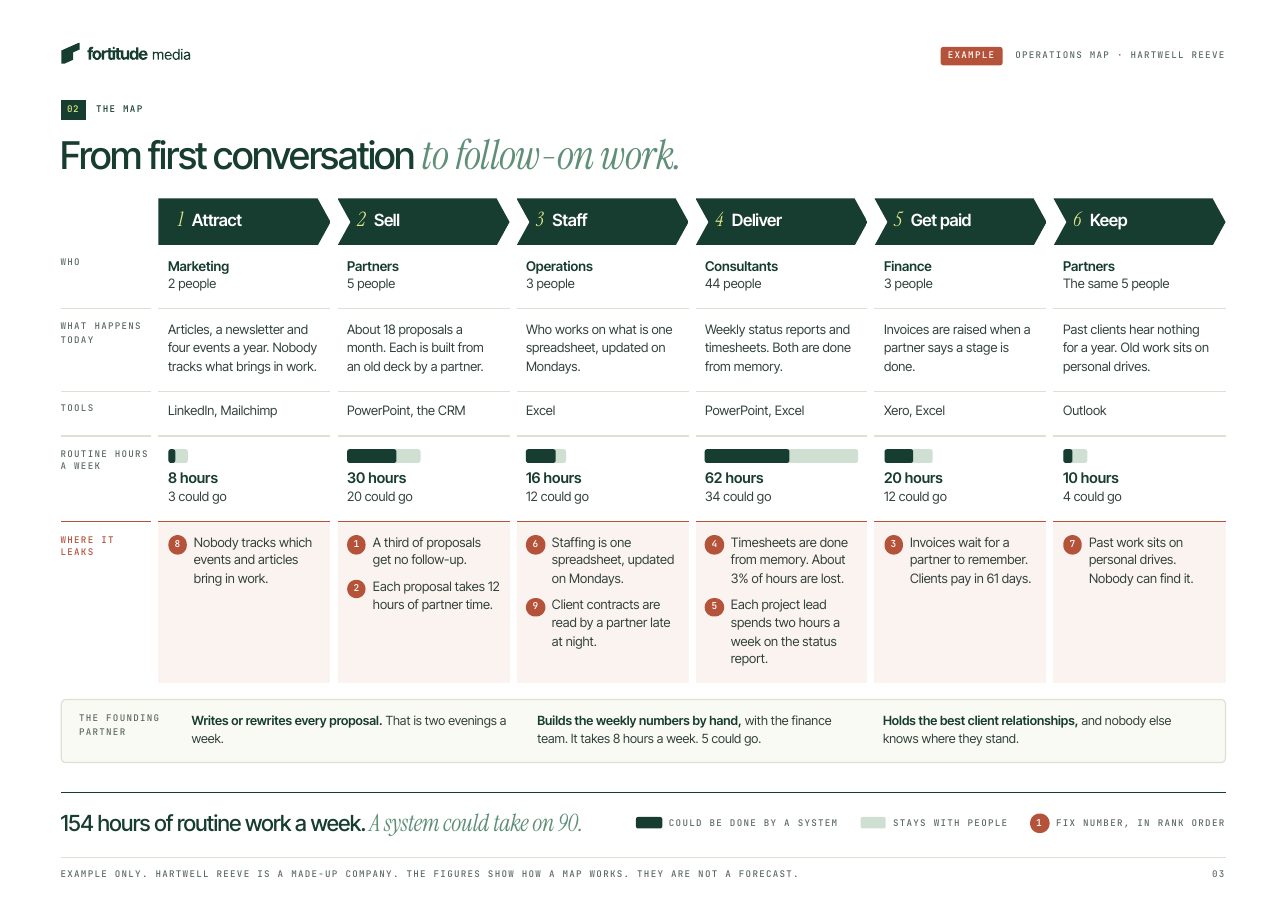
In a firm of 50 to 300 people this work is hard to see because it is nobody's whole job. It is a few hours of everyone's week. Our example Operations Map, built on a made-up law firm of 120 people, finds 290 hours of routine work a week and marks 170 of them as work a system could take on. Those are illustrative figures, not a forecast. How to find where your team's time goes explains how to count your own.
Is this really happening, or is it hype?
It is happening, slowly, and it shows up in hiring before it shows up anywhere else. The evidence is mixed enough to be worth reading with care.
- Adoption is wide. About 35% of UK businesses with ten or more employees used AI by June 2026, against about 12% in late 2023 (ONS).
- Headcount has mostly not moved. The same ONS study found that most businesses using AI report no change in overall headcount, and just under 7% of medium-sized businesses report a decrease. The Bank of England says in its explainer on AI and jobs that nearly 90% of firms in its survey saw no noticeable difference to employment numbers.
- Some roles are being replaced. The CIPD found that 29% of employers had replaced some jobs with technology or automation in the previous 12 months, rising to 46% among large private sector organisations.
- Fewer routine roles are being advertised. A Bank of England economist writing on Bank Underground in August 2026 found that online job adverts for customer service roles had fallen 23% and for administrative roles 22%. The author also wrote that confident attribution to AI "remains premature", because higher employer costs and other shocks overlap with it.
- Leaders plan to hold headcount. In Microsoft's survey, 45% of leaders said they were considering keeping headcount where it is and using AI as digital labour over the next 12 to 18 months.
We run our own firm on this basis. Five of us do the work that took about 30 people at our previous companies, with an extended team to call on when a client needs one. How we run Fortitude sets out what the system does and what a person still does in each area.
What should we change first?
Measure, find the routine hours, and change the rule for support hires. Leave skilled delivery alone until the support work is sorted.
Step 1: Work out revenue per employee for the last three years
Use year-end accounts and average headcount. If the number is flat or falling while revenue grows, headcount is tracking revenue.
Step 2: Split the headcount in two
Count the people whose time clients pay for, and the people who support them. Work out support staff per fee earner, or per consultant. This is the ratio you can change fastest.
Step 3: Count the routine hours, team by team
Sit with each team and list what is repeated every week: copying, chasing, checking, re-keying. Put hours against each item. We do this as an Operations Map, which costs £2,999 for one team and takes about three weeks, and you can do a rougher version yourself. Our prices are on what it costs.
Step 4: Pick one area and set a target in hours
Choose the area with the most routine hours and the least risk if something goes wrong. Most of our clients start with winning new clients, because the payback is quickest. Write down the hours you expect to free and what those people will do with the time.
Step 5: Change the rule for the next support hire
Before you approve a new or replacement support role, ask which parts of the job follow rules and whether a system could do them with a person approving the result. Hire for what is left.
Step 6: Review the ratio every quarter
Put revenue per employee and support staff per fee earner on the board pack. If the hours were freed but the ratio has not moved, the time has been absorbed and nobody has decided what to do with it.
The system that does the routine work is what we call a Business Operating System.
When is hiring still the right answer?
When the thing you are short of is skilled capacity or a relationship. No system takes the client meeting, gives the advice or owns the account.
Hire when you are turning work away for lack of skilled people, when a client needs a named senior person, or when the work is regulated and someone must be accountable. Hire, too, when the routine work in an area is too small to justify building anything. On sales roles in particular, see when to make your first sales hire and what an in-house SDR costs against outsourced outbound.
Be wary of the opposite mistake as well. Cutting support staff before the system works leaves your most expensive people doing the admin.
What to do this month
- Calculate revenue per employee for each of the last three financial years.
- Count fee earners and support staff, and work out the ratio.
- Ask each team lead for the five tasks their people repeat most, with hours a week.
- List the support roles you expect to hire or replace in the next twelve months.
- For each one, mark the parts of the job that follow rules.
- Choose one area to map properly, and name its owner.
If you would like help reading the numbers, book a conversation: 30 minutes with a founder, at no charge, and you leave with three areas a system could take on, in writing.
Frequently asked questions
What is a good revenue per employee for a UK service firm?
There is no single figure. The median law firm in the Law Society's 2026 survey earned £162,060 per fee earner, and UK medium-sized businesses across all sectors turn over about £254,000 per person on our arithmetic. Your own three-year trend, and firms of your type and size, are the comparisons that count.
Does this mean making people redundant?
Not usually. Most UK businesses using AI told the ONS their headcount had not changed. The common pattern is that the firm grows and does not add support roles at the old rate, and people move on to work that needs a person.
Should we freeze hiring until the systems are built?
No. Keep hiring for skilled delivery and client-facing roles if you are short of them. Slow down on support roles where much of the job follows rules, and review each one as it comes up.
Will our clients notice?
They should notice faster replies, fewer dropped handovers and invoices that arrive on time. They should not find themselves talking to a machine about anything that matters. Anything that reaches a client is approved by a person.
How long before revenue per employee moves?
It is a yearly measure, so judge it over twelve months or more. On our timings a first area is live seven to eleven weeks after the start, and the hours it frees show up first in how the team spends its week. The ratio follows when the firm grows without the matching hires.
Sources
- GOV.UK, Rates and thresholds for employers 2026 to 2027 (updated September 2026)
- CIPD, Resourcing and talent planning report 2026 (September 2026)
- PwC, 2026 Global AI Jobs Barometer press release (June 2026)
- GOV.UK, Business population estimates for the UK and regions 2026: statistical release (November 2026)
- Office for National Statistics, Labour productivity, UK: July to September 2026 (November 2026)
- Law Society, Financial Benchmarking Survey 2026 (2026)
- Microsoft, 2025 Work Trend Index: The year the Frontier Firm is born (April 2025)
- McKinsey, The economic potential of generative AI: The next productivity frontier (June 2023)
- Office for National Statistics, Artificial intelligence in UK businesses: 2023 to 2026 (July 2026)
- Bank of England, How will AI affect jobs and wages? (checked November 2026)
- Bank Underground, Canaries in the column? AI exposure and the UK's hiring slowdown (August 2026)