










On this page · 9 sections
The question comes up near the end of the board meeting. A non-executive has read that a competitor is "doing something with AI". An investor wants a line for the next update. The honest answer is that a few people use ChatGPT, one team has bought a tool, and nobody has added it up.
You are in good company. The Office for National Statistics found that about 35% of UK businesses with ten or more staff used at least one AI technology in June 2026, up from about 12% in late 2023. Only 10% of the firms using it said they used it extensively. Most firms have tools. Few have a plan.
This guide sets out what a board is really asking, a one-page structure that answers it, the UK rules directors should have in mind, and what the plan should not promise. It is written for founder-led firms with £5m to £100m in sales, where the plan has to fit on a page.
What is the board really asking for?
Assurance that management knows where AI is used, what it costs, what it returns, what could go wrong and who answers for it. Few directors are asking for a technology strategy.
The Institute of Directors surveyed nearly 700 directors and business leaders in March 2025. Half said their organisation used AI in at least one function, and a quarter were concerned about the lack of an internal AI policy, strategy or data governance framework. Its paper for boards sets out 12 principles, including "Establish board accountability for AI governance".
There is a legal reason behind the question too. Under section 174 of the Companies Act 2006, a director must exercise reasonable care, skill and diligence. A director who cannot say whether staff are putting client data into public AI tools has a gap to close.
Each person at the table wants something different, and the page should answer all of them.
| Who is asking | What they want to know | Where the page answers it |
|---|---|---|
| Investor or chair | Will margin grow as revenue grows? | Where the time goes, cost and return |
| Finance director | What will it cost, and what do we stop paying for? | Cost, set against the cost of hiring |
| Non-executive | What could go wrong, and would we know? | Risk and controls |
| Operations lead | Who does the work, and what happens to my team? | What we automate first, who owns it |
What should a one-page AI plan contain?
Six short sections: where the time goes, what you will automate first, what it costs, the risks and controls, who owns it, and how it is measured. If a section needs more than five lines, the thinking is not finished.
| Section | The question it answers | What to write |
|---|---|---|
| Where the time goes | How much routine work is there, and where? | Hours a week of routine work by team, and how many a system could take on |
| What we automate first | Where do we start, and why there? | Two areas, chosen for volume, clear rules and low risk |
| What it costs | What do we spend, once and each month? | Set-up cost, running cost, and the cost of covering the same hours with people |
| Risk and controls | What could go wrong, and what stops it? | What a person approves, which tools see which data, what is logged |
| Who owns it | Who answers to the board? | One named executive, and who signs off each build |
| How we measure it | How will we know it worked? | Three or four numbers, reported every quarter |
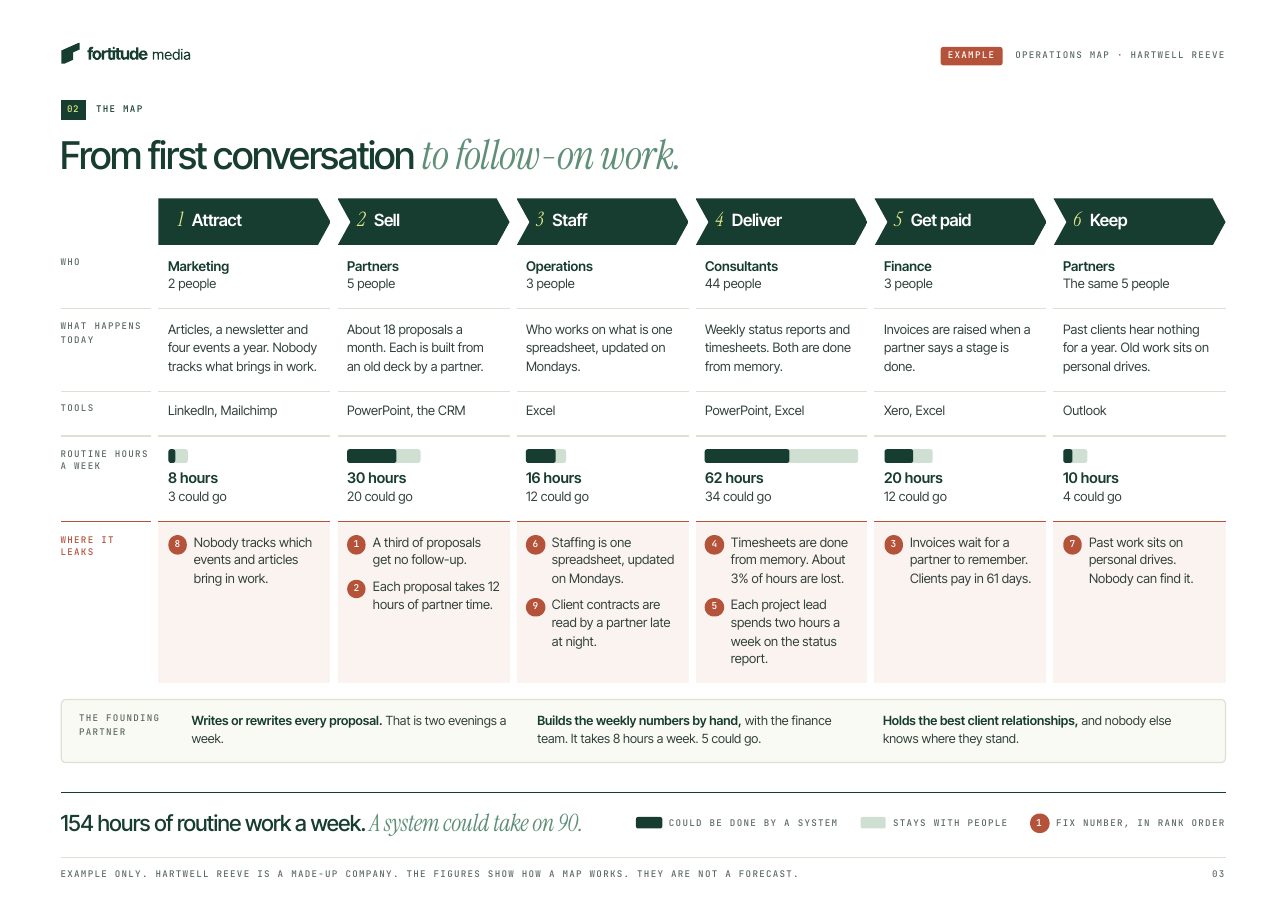
The first section matters most. In a firm your size the routine work is spread across every team in small amounts: copying, chasing, checking, re-keying. Nobody sees the total until someone counts it.
Starting from hours also guards against a common error. An MIT study reported by Fortune in August 2025, based on interviews, a staff survey and 300 public AI deployments, found that more than half of generative AI budgets went to sales and marketing tools, while the biggest returns came from back-office work.
How do we write the plan?
Work through six steps in order. Most of the effort is in the first two.
Step 1: List what is already in use
Ask each team lead which AI tools their people use, paid or free, approved or not, and what goes into them. This list is the inventory the board is asking for, and it is the start of your risk section.
Step 2: Count the routine hours, team by team
For each team, write down the recurring jobs, how often they happen and how long they take. Mark each as work a system could do or work that needs a person. The result is a number the board can hold on to: hours of routine work a week, and the share a system could take on.
Step 3: Choose the first two areas
Pick areas with high volume, clear rules and limited harm if something goes wrong. Leave out anything where the process is not written down, is broken, or happens a few times a year. Automating those costs more than it saves. Our guide to which jobs to automate first covers the choice.
Step 4: Put a cost against each, next to the cost of hiring
The board will compare the plan with what you would otherwise do, which is usually hire. Show both. The same MIT study found that buying from or partnering with a specialist succeeded about 67% of the time, and that internal builds succeeded about a third as often, so say which route you are taking and why.
Our own prices are published, so here they are as one worked comparison. The last two rows come from the example on what it costs, which uses a made-up law firm. They show how to set the numbers out and are not a forecast.
| Line | Cost | Notes |
|---|---|---|
| Operations Map and plan, one team | £2,999 | One-off, about three weeks |
| Operations Map and plan, whole business | £7,500 to £15,000 | One-off, fixed before the work starts |
| Build, for each area | From £6,000 | One-off, and you own it |
| Run | £2,500 to £5,000 a month | No minimum term |
| Example: 130 routine hours a week, covered with people | £187,000 a year | 3.5 more full-time people |
| Example: the same hours, covered with a system | £54,000 a year | To run, after builds of £26,000 |
Step 5: Write the controls
State what a person must approve, which AI tools may see which data, and what is logged. In the systems we build, anything that reaches a customer or moves money is approved by a person, and every action is logged. The Business Operating System page shows how.
Step 6: Name the owner and the numbers
One executive owns the plan and reports to the board. In most firms this is the managing director, the operations lead or the finance director. Then pick three or four numbers that will stay the same from quarter to quarter.
What UK rules and governance points should the board have in mind?
There is no single UK AI law to comply with, so the board's job is to know which existing rules apply. The Law Society's guide to generative AI, updated in June 2026, says there are no current plans to introduce AI legislation in the UK and that regulators are left to apply existing rules.
| Area | What it says | What the plan should show |
|---|---|---|
| Directors' duties | Reasonable care, skill and diligence (Companies Act 2006, section 174) | The board has seen an inventory and approved the controls |
| Data protection | Extra safeguards for significant decisions made with no meaningful human involvement | Where a person reviews decisions about people, and how that is recorded |
| Cyber security | Boards should know who is accountable for the security of AI systems | An owner, and security checked before a tool is bought |
| Sector regulators | Existing rules apply to AI, and the firm stays responsible for outcomes | Which regulator's rules apply and who has read them |
| EU AI Act | High-risk obligations for stand-alone systems apply from 2 December 2027 | Whether you sell into the EU, and whether any use is high-risk |
On data protection, the Data (Use and Access) Act 2025 changed the rules on automated decisions, and the Information Commissioner's Office updated its draft guidance on 31 March 2026 to reflect it. The guidance says human involvement must be "active and not just a token gesture", that the reviewer needs the authority to change the outcome, and that spot checks are not enough. That matters for any plan touching recruitment, credit or pay.
On cyber security, the National Cyber Security Centre's guidance on AI is written for board members without a technical background. It lists questions to ask, including where accountability for AI security sits and what the worst case is if a tool fails. The government's Cyber Governance Code of Practice of April 2025 sets out the actions directors are responsible for.
If you are regulated, read your regulator. The Financial Conduct Authority's review of AI in financial services, published in October 2026, says firms "remain responsible for consumer outcomes" where they use AI, and looks for senior managers who are accountable for AI systems.
If you trade in the EU, check the EU AI Act. Amendments entered into force on 27 July 2026, according to White & Case, and moved the high-risk obligations for stand-alone systems to 2 December 2027. Our guide to UK and EU regulation covers the wider picture.
There is no official checklist for smaller firms yet. The government consulted on a self-assessment tool called AI Management Essentials, and said in its February 2026 response that it will develop future guidance aimed at small and medium firms. Until then, the IoD's 12 principles are a sound free checklist.
What should the plan avoid promising?
Job cuts, a payback date you cannot measure, and work with no errors. Each is tempting on a board paper, and each tends to come back to you.
Start with jobs. The ONS found that around half of businesses reported no effect on headcount from AI, and that among firms using AI to improve operations, 63% reported no change and 6% a decrease. Promise hours taken off people and say what those hours will be used for. If the plan does involve fewer roles, say so plainly and early.
Savings that are assumed and never counted are the second trap. A Gartner survey of 210 sales leaders in early 2026 found that AI saved sellers an average of 4.8 hours a week, yet 72% of sales organisations put little of that time back into high-value work. A fifth reported a negative return of 50% or more on their AI spending. Saved time only counts when you decide in advance where it goes.
Nor should the plan promise perfection. AI makes mistakes, so the page should say where a person checks and what happens when the system is unsure.
Last, avoid a pilot with no end. The MIT study found that about 5% of pilots produced rapid revenue growth and most had little measurable effect on profit. A plan that says "we will run some pilots" is likely to stop there, and our guide on why AI pilots stall explains the pattern.
There is also a case for doing less. If the counting in step 2 shows little routine work, or the processes are not yet written down, the right plan for this year may be to write them down and set a policy for the tools staff already use. That is still a plan.
How should we report against the plan?
On one page each quarter, with the same numbers every time. A board that sees a changing set of measures will stop trusting them.
Four numbers cover most plans: routine hours a week taken on by a system, against plan; what the freed hours were used for; the share of items a person sent back at approval; and spend against budget, one-off and monthly. Add one line on incidents, even when the line says none, and one line on what comes next.
If the plan needs money the board has not approved, our guide to getting a board to approve budget for AI search shows how to make the case, and the same approach works here. We run our own firm on a single page: the system writes it every morning, and a person decides what to do about it. The detail is on how we run Fortitude.
What to do this month
- Ask each team lead for a list of the AI tools their people use, and what data goes into them.
- Write a one-page policy: which tools are approved, what must never be entered, and who to ask.
- Count the routine hours in one team, job by job, to test the method.
- Name the executive who will own the plan and report on it.
- Draft the six sections on one page and take it to the next board meeting for challenge.
- Agree the three or four numbers you will report every quarter.
If you would like a second pair of eyes on the draft, book a conversation: 30 minutes with a founder, at no charge, and you leave with three areas a system could take on, in writing.
Frequently asked questions
Do we need an AI policy before we have an AI plan?
Yes, a short one, because staff are already using the tools. One page is enough to begin with: which tools are approved, what must never be entered into them, and who approves a new use. The inventory in step 1 tells you what the policy has to cover.
Who should own AI at board level in a firm our size?
One named executive with authority over operations, usually the managing director, the operations lead or the finance director. IT should be involved but should not own it alone, because the plan is about how work gets done.
How much should a firm our size budget?
Work it out from the hours. Count the routine work, decide which areas to build, then compare the cost with covering the same hours by hiring. Our fixed prices for a map, a build and monthly running are on what it costs.
Is there a UK AI law we have to comply with?
Not a single one. Existing law applies, including directors' duties, data protection and your sector regulator's rules. The ICO's draft guidance on automated decisions is the most specific text for most firms. If you trade in the EU, check whether the EU AI Act applies to you.
How soon will the board see a result?
It depends on what you build. For our own work, a map and plan take about three weeks, each area takes four to eight weeks to build, and the first area is live seven to eleven weeks after we start. The first quarterly report should show hours moved, not profit.
Sources
- Office for National Statistics, Artificial intelligence in UK businesses: 2023 to 2026 (July 2026)
- Institute of Directors, AI governance in the boardroom (June 2025)
- legislation.gov.uk, Companies Act 2006, section 174 (checked November 2026)
- Fortune, MIT report: 95% of generative AI pilots at companies are failing (August 2025)
- The Law Society, Generative AI: the essentials (updated June 2026)
- Information Commissioner's Office, What does the UK GDPR say about ADM? Draft guidance (updated March 2026)
- National Cyber Security Centre, AI and cyber security: what you need to know (February 2024)
- GOV.UK, Cyber Governance Code of Practice (April 2025)
- Financial Conduct Authority, AI in financial services: good practice and areas for improvement (October 2026)
- White & Case, EU AI Omnibus enters into force, amending the AI Act (2026)
- GOV.UK, AI Management Essentials tool: government response (February 2026)
- Gartner, AI saves sellers nearly five hours per week, yet 72% of sales organisations fail to reinvest the time (May 2026)