









On this page · 9 sections
- Why do clients say no to case studies?
- How do you get a case study a client will approve?
- What should a B2B case study include?
- How do you write a case study without naming the client?
- What if the client will only approve part of it?
- Where should you publish a case study?
- What to do this month
- Questions founders ask
- Sources
Every founder-led firm has a result it would love to publish and a client who has not said yes. The work was good, the numbers moved, the client was pleased on the call. Then the draft went to their marketing team, then to legal, then nowhere. Or the answer came back that their contract does not allow it.
That lost case study costs more than it used to, because buyers decide before they talk to you. 6sense's 2025 Buyer Experience Report found that buying groups had ranked their preferred vendors before first contact in 94% of cases, and bought from that first choice 77% of the time. Whatever convinces them has to be public already. Specific proof also travels into AI answers: in a Princeton and IIT Delhi study presented at KDD 2024, adding quotations from relevant people raised a source's visibility in generative answers by about 41%, and adding statistics by about 34%, on a research engine, so treat the figures as directional.
This guide covers why clients stall, a six-step process that gets case studies approved, what to include so buyers and AI assistants can use it, how to write one that does not name the client, and where to publish it.
Why do clients say no to case studies?
Usually not because they are unhappy. They say no because saying yes carries a small risk for them and no obvious benefit, and because nobody on their side owns the decision.
| What the client says | What is behind it | What usually resolves it |
|---|---|---|
| "Our contract does not allow it" | A confidentiality clause | Read the clause, ask for a written exception, or offer an anonymised version |
| "We do not share our numbers" | Fear of helping competitors | Percentages, ratios or indexed figures agreed with them |
| "Compliance has to approve anything external" | Regulated sector | Build their review time into the plan and send one clean draft |
| "We would rather not say we had that problem" | Reputation | Frame the problem as common in their sector, and show what they did about it |
| Silence | Nobody owns it | One named approver and a date |
| "We are too busy" | Effort | You do the writing; they give 30 minutes and an approval |
Most of these are solved before they arise, which is why the process starts on day one.
How do you get a case study a client will approve?
Make approval the expected last step of the work rather than a favour asked afterwards, and make each step easy for the client to say yes to.
Step 1: Agree the possibility at the start
Put one line in your proposal: at the end of the work you will ask whether the client would be willing to be a case study, they can say no, and nothing is published without their written approval of the final text. Agree at the same time what a good result would look like and how it will be measured. Clients agree to a principle far more readily at the start than to a surprise at the end.
Step 2: Record the starting point and ask for numbers early
Write down the baseline when the work begins, dated, and take it from the client's own systems where you can. A figure the client already trusts is one they will approve. Helm Club's case study describes its measure this way: "Qualified calls a week, reported on one page every Monday and checked against Helm's own member records rather than a platform dashboard."
Step 3: Interview the client
Ask for 30 minutes on a call. People speak more vividly than they write. Ask what was happening before, why they acted then, why they chose you, what changed, and what they would tell a peer considering the same step. Record it with their permission.
Step 4: Draft it in their words
Build the quote from what they said, trimmed for length but never reworded into something they did not say. The UK advertising code requires marketers to "hold documentary evidence that a testimonial or endorsement used in a marketing communication is genuine" and to hold contact details for the person who gave it (CAP Code, rule 3.47). The ASA's advice on testimonials says showing a testimonial is genuine has two elements: that it comes from a real person, and that it reflects what they said.
Step 5: Send one clean draft to one approver
Send the finished text, laid out as it will appear, to one named person, with a date for comments. List what they are approving: the figures and their source, the quote, their name, title and logo, and where the case study will be used. Ask them to mark anything they cannot approve rather than rewrite the whole piece. Several drafts to several people is how case studies die.
Step 6: Keep a record of approval
Keep the email in which the client approves the final text, with the date, the approver's name and role, where it may be used, and their contact details. The CAP Code says marketing "must not feature a testimonial without permission" (rule 3.50), and the ASA has upheld complaints where marketers could not show they held it. The ASA has accepted testimonials sent from a provable company email address as evidence, so an approval from the client's work address is a sound record.
What should a B2B case study include?
A result a buyer can check, stated early, with the client's own words beside it. Buyers skim for evidence that you have solved their problem before; AI assistants look for specific, attributed facts they can repeat. In a 2026 analysis of 1.2 million ChatGPT answers by Kevin Indig, reported by Search Engine Land, 44% of citations came from the first 30% of a page, so put the result near the top.
| Part | What it contains | Why it matters |
|---|---|---|
| Headline | The problem or the result in one line, with the client's name | The line a buyer remembers and an assistant can quote |
| At a glance | The problem, what was done and the result, in three short parts | Lets a busy buyer stop there |
| Key facts | Client, sector, size, services, dates | Lets buyers and assistants match the case to a question |
| The story | Before, the decision, what was done and by whom, what changed | Shows how you work |
| The result | A number with a date and its source | The proof itself |
| The quote | A named person and their role, in their words | Independent confirmation |
Our own case studies follow this pattern. The ID-Pal case study opens with "AI could describe ID-Pal. It never recommended it.", then gives the problem, what we did and the result in three short parts, and a dated result: "UK buyer questions where AI names ID-Pal: none in May, two in August, four in September 2026." The quote is attributed to Dan Brooksbank, Marketing Director: "Fortitude undertook specialist research and identified the primary cause within the first week of working together and had the fix live in the first month."
Three habits make a case study more believable:
- Say who did what. The TCC Group case study says: "TCC chose to build it with its own team, and the new tcc.group is live, built to the plan, with nothing about it depending on Fortitude."
- Label a target as a target. Helm Club's says: "Qualified calls a week started at four, and the target is fifteen by the end of November."
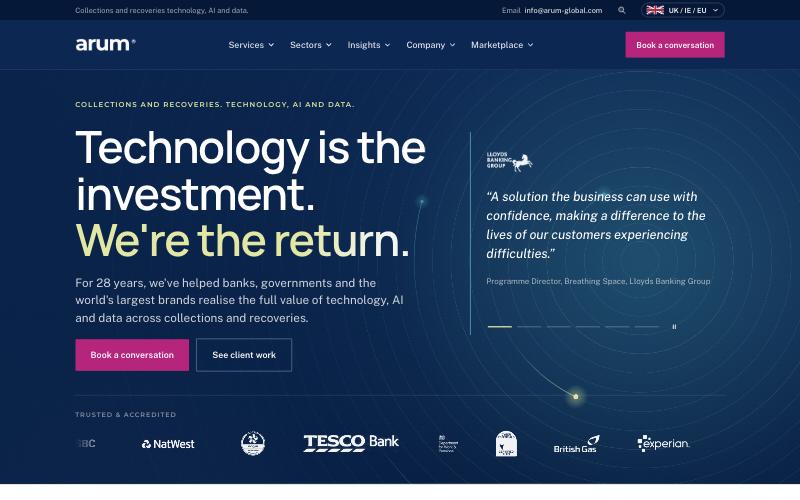
- Lead with a number. When we rebuilt arum's site, "Each of the 12 case studies leads with a number, and each of the nine sector pages names the regulation in play." The arum case study states its headline figure plainly: "310 pages rebuilt across three regions, in weeks."
How do you write a case study without naming the client?
Describe the client precisely, keep the numbers and the quote, and remove what would identify them. UK agency Equinet puts it well in its guide to anonymous case studies: "Specific context builds credibility."
Remove: the name and logo, named individuals, exact revenue or headcount, product names, distinctive locations, and dates that match a public announcement.
Keep: the sector, a size band, the region, the regulation in play, the problem, what was done, the result as a percentage or ratio if the client prefers, the timescale, and a quote attributed by role, for example "Head of Operations, a UK wealth manager".
Then test it: could a competitor, a journalist or the client's own staff identify them? In a small market, blur further. An anonymised case study still needs the client's agreement if your contract covers their information, and the evidence rules on testimonials apply whether or not a name appears.
| Named | Anonymised | |
|---|---|---|
| Trust with buyers | Highest: a buyer can check it, even call the client | Good if specific, weak if vague |
| Use by AI assistants | Connects your firm with a named client and sector that assistants can cross-check | Supports what you say you do, but cannot be cross-checked |
| Approval effort | Higher: comms, legal, sometimes the board | Lower, but still needs agreement |
| Figures | Real figures with dates | Percentages, ratios or ranges agreed with the client |
| Quote | Name and role | Role and sector only |
| Best for | Proud clients, results they want known | Regulated clients, sensitive results, confidentiality clauses |
What if the client will only approve part of it?
Take what they will give, and publish nothing beyond it. Between a full case study and nothing there are several useful steps: a named case study with figures shown as percentages; a named quote without figures; an anonymised case study with full figures; permission to use their logo; or agreement to act as a reference when a prospect asks. Each one is proof, and each can grow into more later.
Where should you publish a case study?
On its own page on your website first, then wherever buyers already look.
- Your website. One page per case study, with its own address, in plain text on the page rather than only in a downloadable PDF, linked from the relevant service and sector pages. The main AI crawlers do not run JavaScript, so key text belongs in the page's HTML, as how AI crawlers read your website explains.
- The founder's LinkedIn. A short article on what the client faced and what changed, linking to the full case study; whether the founder should post on LinkedIn covers why that matters.
- Proposals and pitches. The same page, sent to the prospect whose problem matches.
- Trade press and awards. A strong, approved result is a story for the client's trade press and a ready-made award entry.
- Review platforms. A client who approves a case study will often write a review too, as how to get B2B clients to leave reviews explains.
What to do this month
- List your five best results from the last two years and what each client has approved so far.
- Add a case study line to your proposal template.
- For every current project, write down the starting figures, dated, and where they came from.
- Book 30-minute interviews with two clients whose results are in.
- Create an approvals folder holding the final text, the approving email, the date and the approver's contact details for every case study and testimonial you publish.
Frequently asked questions
Do we need a signed consent form for a case study?
Not usually a formal form. What matters is evidence that the client approved the final text and the uses you plan. An email from the client's company address approving the attached final version, kept with the date and their contact details, is the kind of evidence the ASA has accepted. If your contract sets out a specific process, follow it.
Can we use a client's logo without asking?
Ask first, in writing. A logo on your site implies the client endorses you, and it is their trade mark. Logos used without permission can cost you the relationship, and logos from clients a buyer does not recognise add little anyway.
Our contract has a confidentiality clause. Can we still write a case study?
Read the clause. Many cover the client's information rather than the fact that you worked together, but some cover both. Ask the client for a written exception, offer an anonymised version, and take legal advice if the wording is unclear.
How long should a B2B case study be?
As long as the story needs, with the result and the key figure in the first third of the page. A short summary page with a clear headline, three-part overview and dated result will do more than a long narrative that hides the number. Studies disagree on ideal length, so write to the question rather than a word count.
What if the person who approved it leaves the client?
Their approval was given on behalf of the organisation, so the case study can usually stay. Keep the record, update the contact details the advertising code requires you to hold, and review every case study once a year. If the client asks for it to come down, take it down promptly.
Can we use AI to write case studies?
For structure, summaries and tidying, yes. Never use it to write or polish a quote, or to fill in a figure: the quote must reflect what the client said, and the figure must come from a source you can show.
Case studies are the proof buyers look for before they call, and the facts AI assistants repeat when they recommend a firm. Ours are at our work; if you want help turning your best results into approved, publishable proof, that is part of Reputation That Wins.
Sources
- 6sense, 2025 Buyer Experience Report (November 2025)
- arXiv, Aggarwal and others, Princeton and IIT Delhi: source visibility in AI-generated answers, KDD 2024 (June 2024)
- Search Engine Land, Kevin Indig's analysis of 1.2 million ChatGPT answers (February 2026)
- ASA and CAP, UK Code of Non-broadcast Advertising, section 3 (September 2026)
- ASA and CAP, Testimonials and endorsements, AdviceOnline (September 2026)
- Equinet, How to write a gripping case study without naming the client (May 2025)