










On this page · 10 sections
- How big is the late payment problem in UK B2B?
- Which finance jobs follow rules?
- What do the common accounting systems already do?
- What must stay with a person?
- What controls would an auditor expect?
- How do you set it up?
- Is it cheaper than another finance hire?
- What to do this month
- Questions founders ask
- Sources
Sales are up, so invoices are up, and your finance lead has asked for another pair of hands: someone to raise invoices, send statements and chase. Before you approve the hire, look at what the job is made of. Most of it follows rules, and your accounting system already does part of it without being asked twice.
The cost of getting it wrong is well measured. Research for the Department for Business and Trade, published in July 2025, estimates that UK businesses are owed £26 billion in late payments at any given time, and that staff spend 133 million hours a year chasing it. A medium-sized business affected by late payment spends 324 staff hours a year on chasing alone.
So the answer is yes for the routine part and no for the part that needs a person. This guide covers the late payment figures, which finance jobs follow rules, what the common accounting systems already do, what must stay with a person, and the controls an auditor would expect.
How big is the late payment problem in UK B2B?
Large, and more common as firms grow. The government's research, carried out by London Economics, found that over 1.5 million businesses, 28% of the total, are affected by late payment each year. It puts the cost to the economy at almost £11 billion a year and estimates that 14,000 businesses close each year because of it, or 38 every day.
| Measure | Figure | Source |
|---|---|---|
| Owed in late payments at any given time | £26 billion | Department for Business and Trade, July 2025 |
| Average owed to each business affected | £17,000 | Department for Business and Trade, July 2025 |
| Staff hours a year chasing, small business affected (10 to 49 staff) | 138 | Department for Business and Trade, July 2025 |
| Staff hours a year chasing, medium business affected (50 to 249 staff) | 324 | Department for Business and Trade, July 2025 |
| Average owed in unpaid invoices, SME survey | £66,770 | Bibby Financial Services, February 2026 |
| SMEs saying customers take longer to pay than a year ago | 62% | Bibby Financial Services, February 2026 |
The last two rows come from Bibby Financial Services, which surveyed 1,000 SME owners and decision makers. Bibby is a finance provider, so treat it as a lender's view. The official research points the same way: four in five of the smallest firms surveyed reported no late payment issues, but about half of the medium-sized firms had overdue invoices, payment terms longer than 60 days, or both.
The law is changing. The Commercial Payments Bill, introduced to Parliament in May 2026, would cap payment terms at 60 days with strictly limited exemptions and make interest on late payments mandatory at 8% above the Bank of England base rate. The government says there will be a lead-in time and a transition period before the powers come into force, so check where it has reached before you rely on it.
You already have rights. GOV.UK sets statutory interest on a late business-to-business payment at 8% plus the base rate, and you can also claim a fixed sum for recovery costs: £40 on debts up to £999.99, £70 up to £9,999.99 and £100 on £10,000 or more.
Which finance jobs follow rules?
More of them than most finance teams assume. A job follows rules if you can write down what starts it, what happens next and when it is finished. Raising an invoice when a contract is signed is a rule. Deciding whether to let a struggling client pay in three parts is not.
| Job | Follows rules? | What a system can do | What stays with a person |
|---|---|---|---|
| Raising an invoice when work is agreed or delivered | Yes | Create it from the deal or the timesheet and send it the same day | Approving anything unusual |
| Regular monthly or quarterly invoices | Yes | Create and send them on schedule | Changing the price |
| Reminders before and after the due date | Yes | Send them on a schedule and stop when the money arrives | The wording, and who is left off the list |
| Matching receipts to invoices | Mostly | Match bank transactions to open invoices | Part payments and odd references |
| The weekly cash and debtor report | Yes | Build it from the ledger and send it | Deciding what to do about it |
| Phone calls to late payers | No | Tell the caller who to ring, with the history | The call |
| Disputed invoices | No | Flag them and gather the papers | Resolving the dispute |
| Credit notes, write-offs and payment plans | No | Prepare them for approval | The decision |
Late invoices are often the firm's own doing. The Small Business Commissioner's guidance says to send the invoice immediately after completing the work, not in a batch at month end, to find out who handles payment, and to ask for a purchase order number early. Each of those is a rule a system can follow more reliably than a busy person. An invoice also has to contain the right things: GOV.UK lists a unique identification number, both companies' names and addresses, a clear description, the supply date, the invoice date and the amounts.
Clear terms help before any invoice is sent. If your prices and payment terms are stated plainly, fewer invoices come as a surprise; we cover the case for that in should a B2B firm publish its prices?
What do the common accounting systems already do?
More than most firms have switched on. Check these before you look at anything new.
| Feature | Xero | FreeAgent |
|---|---|---|
| Automatic reminders | Reminders before or after the due date; Xero checks bank feeds so it only chases invoices still unpaid | Automated late payment reminders, plus thank-you emails once paid |
| Regular invoices | Automated repeating invoices | Recurring invoices that send themselves |
| Online payment | A pay now button for card payment through Stripe or direct debit through GoCardless | One-click payment from the invoice |
| Tracking and matching | Shows which invoices are sent, opened, overdue or paid | Matches bank transactions to open invoices |
| Who pays late | Aged receivables report | Insights on fastest and slowest-paying customers |
The details are from Xero's invoicing page and FreeAgent's invoicing page; both are the vendors' own descriptions, and features vary by plan. Other systems have their own versions, so read the help pages for yours.
Two limits apply to all of them. They only know what is in the accounting system, so if the deal lives in a CRM and the hours in a timesheet tool, somebody still re-keys them before an invoice exists. And a reminder email is the weakest form of chasing. It works on customers who forgot. It does little for those who are choosing not to pay.
One change is coming to every system. ICAS reports that the 2025 Autumn Budget confirmed all VAT invoices will have to be issued in a specified electronic format from April 2029.
What must stay with a person?
Anything that needs judgement, a relationship or authority over money. In our experience these six should never be left to a system alone:
- Disputes. A customer who says the work was wrong needs a conversation, not a fourth reminder.
- Your biggest accounts. Decide by name who is taken off automatic chasing and handled personally.
- Credit notes and write-offs. A system can prepare them. A named person approves them.
- Payment plans and stopping work. These are commercial decisions with consequences beyond the ledger.
- Charging interest. The sum is a rule; whether to claim it from a customer you want to keep is a judgement.
- Signing off the books. Your accountant does that.
This is how we run our own finance. The system raises the invoice when work is agreed, chases late payers on a schedule and does the bookkeeping. A founder approves what is paid, and our accountant signs off the books. The rest of the firm is set out in how we run Fortitude.
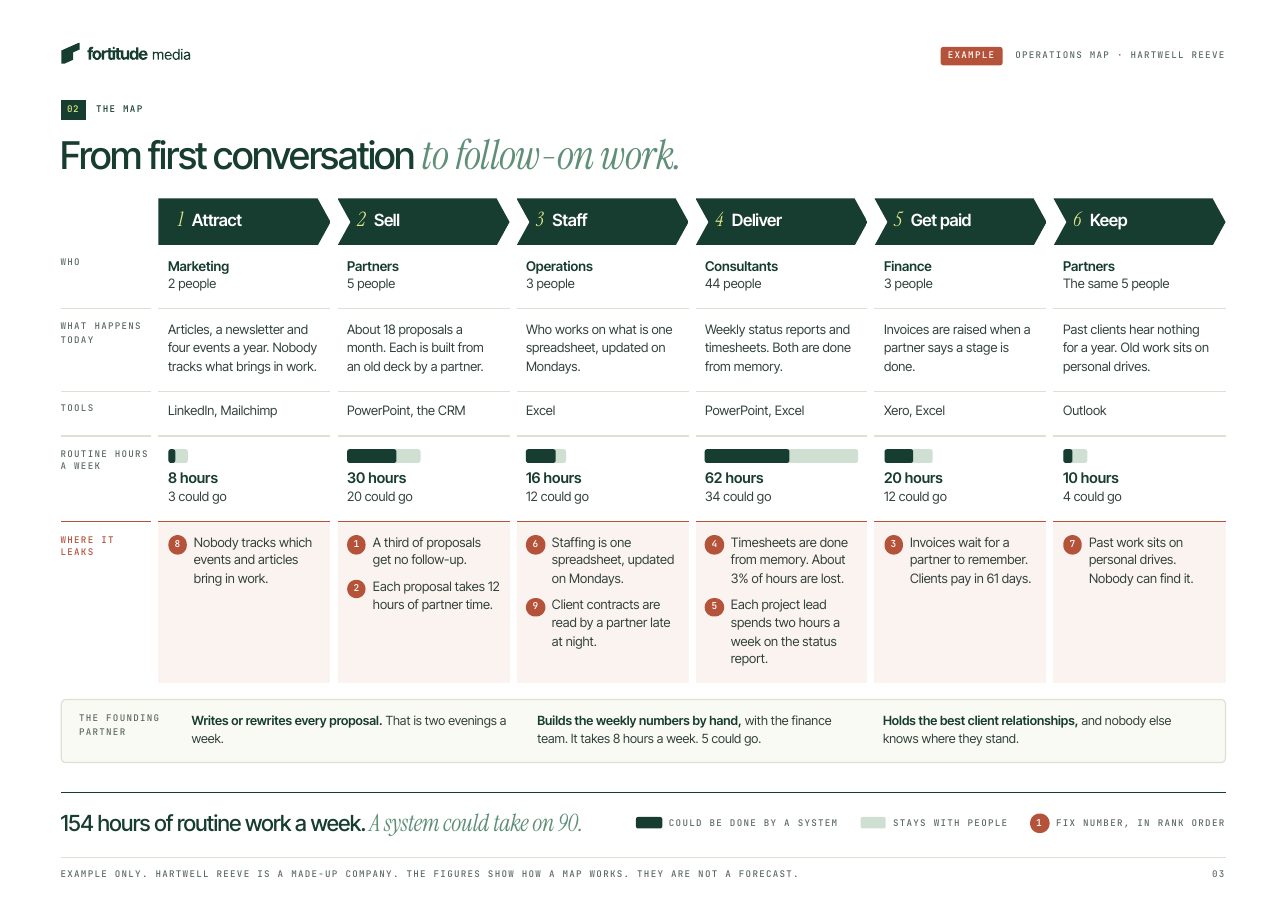
Our example map for a made-up commercial law firm shows the same split. Of 28 routine hours a week in credit control, a system could take on 14. The other half is calls, disputes and judgement, and it stays with people.
What controls would an auditor expect?
The same ones as with a person doing the work: separate duties, approval limits, reconciliations and a record. Automation does not remove the need for them.
An ACCA technical article on internal controls sets out the standard types, including segregation of duties to reduce the risk of error and fraud, authorisation and approval limits, and arithmetic controls such as reconciliations. For revenue in particular, an ICAEW article on auditing revenue notes that completeness and cut-off may carry the higher risk: whether everything delivered was invoiced, and in the right period.
Applied to automated invoicing and chasing, that means:
- Separate duties. Whatever raises invoices cannot also issue credit notes, write off debts or change bank details without a person's approval.
- Approval limits. Set a value above which an invoice, credit note or discount needs a named approver.
- Completeness check. Each month, compare work delivered with invoices raised, so nothing is missed.
- Bank reconciliation. Someone who does not raise invoices reconciles the bank to the ledger.
- A log. Every automated action is recorded: what was sent, to whom, when and why.
- Change control. Templates, price lists and reminder wording change only with approval.
Tell your accountant before you switch it on, not after.
How do you set it up?
Start with what you already pay for, fix the handover into finance, then decide whether anything needs building. The method below takes a few weeks.
Step 1: Count the work
List every invoice type, how many you raise a month and how long each takes, then do the same for chasing. How to find out where your team's time goes gives the method.
Step 2: Write down the rules
For each invoice type, record what triggers it, where the details come from and who checks it. For chasing, write the schedule: for example, a reminder a week before the due date, another on the day, a firmer one at seven days and a phone call at fourteen.
Step 3: Switch on what your system already does
Turn on reminders, repeating invoices and online payment. Write the reminder wording yourself, and remove the accounts you want handled personally.
Step 4: Fix the handover into finance
Find where details are typed twice: from the CRM, the contract or the timesheet into the accounting system. That gap is usually where invoices are delayed, and joining it is the part that may need building.
Step 5: Set the controls and the approvals
Agree the limits and who approves what. Brief your accountant.
Step 6: Review it weekly
Put debtor days, the overdue total and the list of disputes on one page each week. Check the public record on large customers too, using the government's service to check when large businesses pay their suppliers.
Is it cheaper than another finance hire?
It depends on how much needs building. Switching on features you already have costs a few days. A system built to join your tools costs about what a hire does if finance is the only area it covers.
| Route | Typical cost | Best for | Limit |
|---|---|---|---|
| Switch on what your accounting system does | Included in the subscription, plus set-up time | Firms whose invoices start in the accounting system | Nothing joins it to the CRM or timesheets |
| Another credit controller | £21,000 to £32,000 salary (National Careers Service); about £37,000 a year at the top once employer costs are added | Heavy phone chasing and many disputes | One person's hours, and time to recruit |
| A built system, run for you | Build from £6,000 for each area; running £2,500 to £5,000 a month, priced by number of areas | Firms automating several areas on one system | For finance alone, no cheaper than a hire |
The hire is costed on a £32,000 salary plus employer National Insurance at 15% above £5,000 (GOV.UK) and a 3% minimum pension, before recruitment and software; we work through the same sums for a sales hire in in-house SDR or outsourced outbound. Our prices are on what it costs, and the cost of automating a department against hiring compares the two in more detail.
If invoicing and chasing is the only routine work you want off people, the first route is the answer and you may not need us. A built system earns its cost when finance is one of several areas on the same Business Operating System, or when the delay sits in the handover between tools. If most of your debt is disputed, hire the person.
What to do this month
- Pull your aged debtor report and split what is overdue into forgotten, disputed and deliberate.
- Count the invoices you raise a month and the days between finishing work and sending each one.
- Switch on automatic reminders, repeating invoices and online payment in your accounting system.
- Write the chasing schedule and the list of accounts handled personally.
- Agree approval limits for credit notes and write-offs, and tell your accountant.
- Add statutory interest and your payment terms to your contracts and invoice template.
If you would like a view on which parts of your finance admin a system could take on, book a conversation: 30 minutes with a founder, at no charge.
Frequently asked questions
Can we charge interest on late invoices?
Yes. GOV.UK sets statutory interest on late business-to-business payments at 8% plus the Bank of England base rate, unless your contract sets a different rate. You can also claim a fixed sum of £40, £70 or £100, depending on the size of the debt. Send a new invoice if you add interest.
Will automated reminders annoy our good customers?
Not if you set them with care. Write the wording yourself, start with a polite note before the due date, and take your key accounts off the schedule so a person handles them. Xero's reminders stop once the bank feed shows the invoice is paid.
Do we need new software?
Usually not at first. Most firms have reminders, repeating invoices and online payment available in the system they already pay for. New work is needed only where details are re-keyed between tools.
What will the Commercial Payments Bill change?
As introduced in May 2026, it would cap payment terms at 60 days with limited exemptions, make interest on late payments mandatory and give the Small Business Commissioner powers to investigate and fine persistent late payers. The government has said it will not apply retrospectively and that there will be a transition period.
Does automating invoicing replace our finance team?
No. It removes the typing and the routine reminders. Your team keeps the calls, the disputes, the approvals and the reconciliations, and your accountant still signs off the books.
Sources
- Department for Business and Trade and London Economics, Late payments research: estimating the total economic cost of late payments (July 2025)
- Bibby Financial Services, Two fifths of SMEs can't pay staff on time due to late payment (February 2026)
- GOV.UK, Commercial Payments Bill: overview (May 2026)
- GOV.UK, Late commercial payments: interest on late commercial payments (checked November 2026)
- GOV.UK, Late commercial payments: claim debt recovery costs (checked November 2026)
- GOV.UK, Invoices: what they must include (checked November 2026)
- Small Business Commissioner, Getting invoices right (checked November 2026)
- Xero, Send invoices (checked November 2026)
- FreeAgent, Invoicing features (checked November 2026)
- ICAS, Autumn Budget 2025: e-invoicing will go ahead from 2029 (November 2025, updated December 2025)
- ACCA, Internal controls (checked November 2026)
- ICAEW, Auditing revenue: dealing with the risks (September 2025)
- National Careers Service, Credit controller job profile (checked November 2026)
- GOV.UK, Rates and thresholds for employers 2026 to 2027 (checked November 2026)
- GOV.UK, Check when large businesses pay their suppliers (checked November 2026)